Tuesday, May 31, 2005

Bubblehead's USS San Francisco Grounding Posts

Posted 2220 07 Jan 2006: The posts below, in the May archives of Ultraquiet No More, are a collection of posts I had put up over the last year at my home blog, The Stupid Shall Be Punished, on the subject of the grounding of USS San Francisco (SSN 711) a year ago today. In chronological order, you can read how one retired submarine officer reacted to the biggest public submarine story since the sinking of RNS Kursk, and how others reacted to it as well. Either in the title of the post, or in the first line, there should be a link to my original post. Many of the links within the posts are dead now; in some cases, I replaced them with new links, and in others, the dead links remain.

The main thing that I took away from this tragic story was a reaffirmation of the wonderful brotherhood that exists between shipmates on a submarine -- something non-submariners probably can't fully understand, but I hope they will a little better after reading these posts.

As always, my posts on the San Francisco grounding are written while holding firm to the memory of MM2(SS) Joseph "Cooter" Ashley -- beloved by his shipmates, and honored by submariners everywhere.

Thanks for reading,
Joel Kennedy -- "Bubblehead"

USS San Francisco Grounding

Originally posted 0629 08 Jan:

According to this report from CNN.com, the USS San Francisco (SSN 711) grounded during submerged operations south of Guam, and has now surfaced and is heading back into port. While we call this a "grounding", it actually means the submarine hit the ocean floor while operating submerged. The report also says many crewmen suffered head injuries, so it sounds like they must have smacked the bottom pretty hard. More later...

Update: Here's a BBC article that shows the approximate location of the grounding. From this better chart, it looks like they grounded near the Caroline Islands somewhere close to Yap. It looks like they had just returned from a short deployment in December, so this was probably their first underway since then...

My favorite tin-foil hatters at DU are blathering on about the grounding here...

Staying at PD...

More on San Francisco Grounding

Originally posted 1003 08 Jan:

Here's the official press release from PacFleet.

I found a good web site that has short synopses (synopsii? Whatever the plural of synopsis is...). A Navy Reserve Lieutenant has a website on Peacetime Submarine Accidents, which includes descriptions of the recent groundings off USS Hartford (a surfaced grounding) and HMS Trafalgar (a submerged grounding, like the San Francisco). Also included are less recent submerged groundings of USS Nathanael Greene and USS Ray.

The San Francisco had spent a few months last year in drydock in San Diego, so I got to know the crew pretty well. I'm kind of surprised they were so far south of their home base in Guam less than a month after returning from a short deployment, but I think they do things differently, as far as stand-down time after deployment, with the Guam-based boats.

Update: Here's a good update from Guam's Pacific Daily News. Apparently, the boat was on its way to a liberty visit in Brisbane, Australia. This would explain why they were so far south of their home port so soon after a deployment; Squadron 15 probably wanted them home for Christmas, but the crew also wanted a nice liberty call. I'm guessing that there were probably a few crew member's family members planning to meet them in Brisbane; this is a really bad way to miss out on a good liberty call.

Update 2: Every year all the officers and the enlisted navigation team on every submarine has to go through the collection of "lessons learned" from all the previous submarine collisions and groundings. I've been looking for any information on any of them, other than the ones listed above, that have made it onto the Internet, and so far I've only found one other. It's a listing of the USS Jefferson City (SSN 759) submerged grounding off San Diego in May 1994, on the NAVSEA Damage Control site.

Staying at PD...

USS San Francisco Information

Originally posted 2016 08 Jan:

It looks like the Navy hasn't released any new reports on the San Francisco grounding discussed below, so all that's floating around now is just idle speculation. I saw on some of the more "uninformed" bulletin boards some posters theorizing that the San Fran had maybe collided with a Chinese submarine, rather than with the bottom. This was based somewhat on the reports that the Chinese submarine that had intruded into Japanese waters (discussed in this blog here) had earlier been tracked by the U.S. Navy near Guam. I find this conjecture highly improbable, for the simple reason that we probably wouldn't have released the news of any damage to the San Francisco if it had happened due to a collision. As far as speculation that the San Fran might not have heard the Chinese sub -- well, any sub that a P-3 can track can definitely be detected by a submerged submarine.

Here is the official Commander Nav Base Marianas page on the San Francisco that has some decent background information.

Going deep...

Sailor, Rest Your Oar...

Originally posted 0837 09 Jan:

Word this morning from Guam is that one of the Sailors on USS San Francisco (SSN 711), the grounding of which is discussed below, has died. His identity has not been released pending notification of next of kin. Also, the story provides an update on the status of the injured personnel:

About 23 out of the submarine's 137-member crew suffered a range of injuries, including broken bones, lacerations, bruises and a back injury, according to a written statement from the Navy.

This PacFleet news release says that additional medical personnel have transferred onto the boat, and are treating the remaining injured personnel.

Navy medical personnel were surged overnight and came aboard the submarine at the first opportunity this morning, but the one Sailor’s injuries were extremely serious. The medical personnel, including a doctor, remain aboard and are treating 23 other crew members for a range of injuries including broken bones, lacerations, bruises and a back injury. The submarine remains on the surface and is continuing toward its homeport in Guam, escorted by the Coast Guard cutter Galveston Island and USNS Stockham. The submarine is expected to arrive in port Monday afternoon (Guam time). USNS Kiska and military aircraft are also continuing to assist as required.

Staying at PD...

Updated 1533 14 Jan: Here's a poignant report of the ship's memorial service for Petty Officer Ashley from the Pacific Daily News. No additional comments are necessary...

Updated 1936 14 Jan: Actually, I decided I did need to say more about this. My additional thoughts are here.

USS San Francisco Returns to Guam

Originally posted 0618 10 Jan:

This press release from U.S. Pacific Fleet describes the return of the San Fran to Guam, and announces that the name of the Sailor killed in the accident as MM2(SS) Joseph Ashley of Akron, Ohio. To my eye, it looks like the ship is riding down in the bow; that is, the front end of the ship looks like it isn't riding as high as normal. (Here's a picture of the USS Portsmouth, like the San Francisco a non-VLS Los Angeles Class submarine; notice the bow is riding much higher.) They could have damaged a vent valve on one of the forward ballast tanks, resulting in one of the three forward tanks possibly partially filling. Another possibility I've seen discussed is that the sonar dome may have flooded, but the boat really looks to be riding a lot lower forward that it would have if that happened. On the other hand, she might just have gone over a small wave; we'd need to see more than one picture to make sure this one isn't just anomolous.

Update: Here's another good update from Guam. The SubPac spokesman here comes fairly close to completely ruling out a collision with another sub, but leaves a little wiggle room (the boat struck "something topographical").

Staying at PD...

Submarine Brotherhood

Originally posted 0835 10 Jan:

Steve has started a new blog, Submarine Brotherhood, that has a nice tribute to MM2(SS) Ashley of the USS San Francisco. Bo is another sub-blogger you should check out, if you haven't already...

{Update 07 Jan 2006: Steve's blog has been inactive since May, but it's an invaluable resource for articles printed in The New London Day and New York Times that aren't available anymore. Check out his January archives for many of the articles I reference in the posts immediately below for the full versions of those articles.}

Possible Second Hand Report from San Francisco Grounding

Originally posted 1358 10 Jan:

I really hate to post anything from a bulletin board (especially Free Republic, which can be as bad in its own way as Democratic Underground), but this thread, down in the 900s, has what is claimed to be a relative of one of the San Francisco's Sailors giving a report of what they heard from their son. Part of the thread is as follows:

The incident was very touch and go. They were at depth and near flank speed.The the petty officer at the helm immediately did an emergency blow, (with a broken arm) to surface the ship. [Name's] compartment was filling with water, and while looking for the source was sprayed in the face when he became aware it was not sea water. There were no hull breaches and no high pressure steam leaks. Two of the ships three bow ballast tanks were compromised severly and a air pump rated only for intermittent service was employed for more than 30 hours to provide bouyancy in those tanks. There were two risky option to keep the boat afloat if there were a pump failure, thank goodness the pump held. The hull of the ship actually accordioned. I would like to thank the welders who put her together.
My son said that with the emergency blow, they surfaced very quickly. He also talked about the water leak and fortunatly, it was not sea water. The collision also knocked out the sonar. The sonar guys helped out with other duties and the injured also worked at getting the sub back home. He went up to the control room to help out and said there was a lot of blood around there. The medic and and jg with paramedical experience and a couple of guys with EMT training did a fantastic job on treating the injuries. When a medical doc finally came on board, he highly complimented the work, stitching, etc that this group did. We can be proud of the good work of the crew of the SSN San Francisco. My son said the charts showed open country for clear sailing. The senior people are really beating themselves up over what went wrong. And the crew is also concerned for the Captain, XO, Navigator,etc. He hopes everything will turn out good for them. Yes, the hull is pretty well wrinkled. Our tax dollars were well spent there to be able to withstand such a colliding force. My son said that nothing came apart or was damaged in the engine room. He said when he meets an engineer or designer of the reactor and engine room, he will buy them a beer.

Some of this you obviously have to take with a grain of salt... I doubt that the "Petty Officer at the helm" performed the Emergency Blow, unless the Chief of the Watch and Diving Officer of the Watch were both knocked out of their chairs; unlikely, since they are supposed to be wearing their seat belts if they're running at flank speed. On the other hand, the description of the ballast tanks being "severely compromised" does match with the bow down attitude the ship had. I'll be interested to see if when some more official information comes out, how well it matches with this report.

Update: A sailor from the San Francisco reports that the specifics described in the account above didn't happen on his boat. On the other hand, the descriptions of the damage and the use of the Low Pressure blower ("air pump") match the description from the CSP E-mail above pretty closely, accounting for "translation errors" caused by running it through a non-submariner family member.

Update: Here's a report from the MSNBC website that has similar information to the one above, but which I really can't call any more authoritative. One line in particular stands out as sounding like they got the information from an uninformed speculator than someone who has a clue:

Everyone standing on the bridge was violently thrown forward, NBC News was told.

As anyone who knows anything about submarines knows, the "bridge" is on the top of the sail, and is not manned when the sub is submerged. (It's a free-flood area, so whoever is on the bridge during submerged ops would get very, very wet, then very, very dead.) The space from which the sub is controlled/driven is called the control room. Also, why specify that only those in Control got thrown forward? Obviously everyone on the ship would have been thrown forward (we don't have an inertia-dampeners installed in the non-Control spaces of our submarines... yet...). Overall, I rate this story as "third-hand knowledge that may have come from an Internet bulletin board".

Staying at PD...

Official Information on San Francisco grounding

Originally posted 1937 10 Jan:

Here's a portion of what is purported of an unclassified message sent today by Commander, Submarine Forces Pacific.

At 10 January 1634 local (100134 EST) the USS SAN FRANCISCO returned safely to Apra Harbor, Guam. The ship moored with her own line handlers in a normal submarine configured mooring (AFT draft is 27'-10'' (normal AFT draft is 32') and FWD Draft is above the draft marks with the waterline at the point the towed array faring begins; 0.8 degree STBD list and 1 degree Down bubble indicating by naval architecture calculations that 1 A/B and 2A/B MBTs are most likely flooded). The severely injured Machinist Mate (Engineroom Upper Level Watch at time of grounding) was evacuated immediately and transferred by ambulance to Naval Hospital Guam where a fully staffed medical team was standing by. He is conscious and in stable condition. Approximately fifteen additional injured personnel requiring medical care subsequently departed the ship and were transported to the hospital after taking a moment to meet with family members.
Crewmembers from the USS CORPUS CHRISTI, HOUSTON and FRANK CABLE assisted in linehandling and various return to port evolutions such as propulsion plant shutdown, shorepower cables, and rig for surface. Standing by on the pier was a full complement of watchstanders from USS CITY OF CORPUS CHRISTI (and SAN FRANCISCO stay-behinds) to satisfy all watchstanding requirements for reactor plant shutdown with follow-on inport forward and aft watchsections.
Following the grounding on 8 January, the ship transited on the surface at 8kts with surface escort, USCGC GALVESTON ISLAND to Apra Harbor, Guam. Due to deteriorated weather conditions on the evening of 9 January, the Commanding Officer shifted bridge watchstations to control and shut bridge access hatches to maximize watertight integrity in light of reserve buoyancy concerns. The ship maintained stability throughout the surface transit with continuous operation of the Low Pressure Blower on the Forward Main Ballast Tanks. SAN FRANCISCO has experienced no reactor plant, propulsion train or electrical system degradations as a result of the grounding. The Commanding Officer shifted the Officer of the Deck's watch to the bridge on 10 January in preparation for piloting into Apra Harbor.
The ship's Main Ballast Tank damage and deformation has degraded maneuverability and mandated the use of two tugs to moor in Apra Harbor. A Pearl Harbor Naval Shipyard/NAVSEA Material Assessment Team comprised of a structural engineer, MBT vent expert, air systems expert and naval architect arrived in Guam with special ship salvage and recovery equipment to stabilize the ship pierside as soon as possible. The team, led by Captain [Name], commenced a seaworthiness and repair assessment upon the ship's arrival. Once additional buoyancy measures are in place and testedsatisfactory, the Low Pressure Blower will be secured to allow divers to enter the water to conduct an inspection. While this grounding is a tragedy, with a through investigation led by [Name], we will find out all the facts and then ensure we learn from the mistakes. But, I too believe we have much to be thankful for today, and much to be confident in. An operational warship has returned to port on her own power with all but one of its crew after sustaining major hull damage. The survival of the ship after such an incredibly hard grounding (nearly instantaneous deacceleration from Flank Speed to 4 KTS) is a credit to the ship design engineers and our day-to-day engineering and watchstanding practices. The continuous operation of the propulsion plant, electrical systems and navigation demonstrates the reliability of our equipment and the operational readiness of our crews as a whole.

I can't guarantee that this is an actual message sent out by ComSubPac, (I'm not on the mailing list anymore) but it certainly is in the same tone as similar messages I've seen previously, and if it is a hoax, it's a darn good one, by someone who knows submarines. The description of two flooded forward main ballast tanks matches with the boats attitude as it was coming into the harbor. If true, this message confirms to me the professionalism, dedication, and incredible seamanship demonstrated by the crew in the aftermath of the casualty. I expect we won't hear much more about the specifics of this incident for a while, unless they do determine that there really was an uncharted seamount that the boat hit.

Going deep...

Seamounts near the Caroline Islands

Originally posted 0642 11 Jan:

Robert Hamilton, of the New London, CT, Day, and one of the most informed newpaper writer around on the subject of submarines, has a good article (annoying free registration required after two days) in which he talks to local retired submariners about the area where the San Francisco (SSN-711) ran aground. The article (limited to the blogosphere's requisite four paragraphs) states in part:

•••During the Cold War, the Navy focused on charting the Atlantic because of the threat the Soviet Union posed from that direction. Submariners said that until recently some of the Pacific Ocean charts carried warnings based on soundings made by Captain Cook in the 18th century, and even modern charts can be based on soundings taken 20 miles or more apart.
"Local submariners say the area where the sub was traveling is notorious for no-warning sea mounts; the water depth can change 1,000 fathoms in seconds.
“We know more about the backside of the moon than we do about the bottom of the ocean,” said retired Navy Capt. James Patton, president of Submarine Tactics and Technology in North Stonington.The area in which the San Francisco was traveling, through the Caroline Islands chain, is one of the worst, with dozens of islands rising out of the water and many more uncharted seamounts between them."

I remember transiting once from Perth, W. Australia, to Hobart, Tasmania; the charts for the area basically had only a narrow lanes of sounding data, and a lot of blank areas. The Pacific is a big ocean; there's lots of places we haven't been yet, and the San Francisco may have been in one of those places.

Petty Officer Ashley (SSN-711 Sailor) Info

Originally posted 2011 11 Jan:

Here's a story from an Ohio TV station website that has information, and a picture, of MM2(SS) Joseph Ashley, who was killed in the line of duty onboard USS San Francisco (SSN-711) this weekend. (Hat tip: Kurt) A more personal remembrance piece from the Akron Beacon Journal is here (free registration required). A sample:

``When he had his heart set on something, he would try his best to get it done,'' said his mother. ``I always told him to do what he wanted to do in life, but to be the best at it and to always try his hardest."One day he came home and shared his future plans.``He said, `Mom I passed the Navy test; I'm going to do what daddy did. He always excelled in what he did.'
''He made rank in minimal time and was named Junior Sailor of the Year for the entire Guam naval base.''

I had one shipmate pass away when I was on USS Connecticut (SSN 22). We were in new construction, and he died in an accident at home. He never went to sea on the boat; he earned his dolphins riding other boats while our ship was being built. His mother said his greatest goal was to take the Connecticut out to sea, so when we went out on our second underway, the ship's company committed his remains to the deep. MM3(SS) Richard Keen, was and remains to this day, my shipmate. In the same way I honor Petty Officer Keen, the officers and crew of the San Francisco will always remember and honor Joseph Ashley.

Going deep...

New York Times Goes for the Sensational

Originally posted 1009 12 Jan:

The New York Times, in this article by Christopher Drew (annoying free registration required) tries to dredge up what they can to make the Navy seem uncooperative and secretive regarding the grounding of the USS San Francisco (SSN-711). Excerpts follow:

"The nuclear submarine that ran aground Saturday in the South Pacific hit so "incredibly hard" that about 60 of its 137 crew members were injured and the sailor who died was thrown 20 feet by the impact, according to internal Navy e-mail messages sent by a top admiral...
"The messages were written by Rear Adm. Paul F. Sullivan, the commander of submarines in the Pacific. They paint a more dire picture of the accident, which occurred 360 miles southeast of Guam, than had previously been disclosed. They also hint at the extensive efforts to steady the vessel and save the sailor who died...
"The e-mail also indicated that about 60 crew members had been injured. All the Navy had said publicly was that 23 crew members were treated for broken bones, cuts and bruises.
"The messages said those 23 were hurt seriously enough that they were unable to stand their watch duties as the submarine limped back to Guam. Mr. Ashley said the submarine's captain, Cmdr. Kevin Mooney, told him by phone on Monday that among the injured crew members, "there were a lot of broken fingers, broken arms and legs and one fractured back."

The tone of the article indicates that the Navy had something to hide in their initial reports, whereas I think the Submarine Force has been as forthcoming as possible, especially with information as hard as it was to come by when the boat was still transiting back to Guam. The main information in the article seems to come from a series of E-mails sent by RADM Sullivan, ComSubPac, that I discussed earlier here. The main issue seems to be that there were 60 Sailors injured, rather than the previously reported 23. The Navy had never said there were only 23 injuries; rather, there were 23 injured so badly that they couldn't resume watchstanding duties. It is reasonable to assume that submariners will stand watch with minor injuries when they know that others are hurt more badly; the ship still needs people to operate the ship, especially on the surface. They may not have even reported their more minor injuries until the ship was safely in port.

This article, although informative, disappoints me somewhat in that Christopher Drew, who spent a lot of time with submariners (not me!) in researching his book Blind Man's Bluff, should have known better. I'm sure he is under pressure to get the most sensational story he can, but in this case he should have focused more on the real story of this tragedy -- the total professionalism, dedication, and bravery shown by the officers and crew of the San Francisco.

Update 1311 12Jan: Here's another version of the article that might not require registration. Based on my good friend Bothenook's comment, I re-read the article, and decided that, overall, it's actually fairly well-written and balanced. I guess I fell victim to one of the classic blunders: Reading a wacky Democratic Underground post about the grounding that linked me to the NYT article; I was still in the mindframe of idiotarian mocking when I read the article.

Going deep...

Pictures of USS San Francisco Pierside

Originally posted 2128 12 Jan:

Donmac was kind enough to let me link to 4 pictures he obtained of the San Francisco pierside in Guam. The top two pictures show how low she's riding in the bow; the front end of the towed array fairing is essentially in the water. The frothing in the water is from air being forced into the forward ballast tanks to keep the water level in the ballast tank as low as possible. The air pressure is either coming from the ship's Low Pressure air blower, or, more likely, a temporary system they have hooked up being supplied from the pier. The capstan is up just aft of the forward hydophone; this isn't normal, but it could have been used in mooring, since the ship was riding so low forward, or it could have been damaged in the collision (I think the former is more likely).

Going deep...

This San Francisco Article Has The Right Focus

Originally posted 0956 13 Jan:

I wrote yesterday about the NYT article that I felt had the wrong "tone" -- trying to highlight the "Navy withheld information" part rather than the bravery and skill of the crew. An article today by Robert Hamilton of The New London Day (who I discussed earlier here) does, in my opinion, a much better job. This article (registration required) begins as follows:

"It is increasingly clear that the submarine that hit a seamount in the Pacific Ocean last week came close to being lost and that only the valiant efforts of its crew kept it afloat, Navy sources said Tuesday.
"With uncontrolled flooding in its forward ballast tanks, the USS San Francisco had to run a low-pressure air pump for 30 hours straight to maintain buoyancy on its trip home, Navy sources said. The pump is rated for only intermittent use.
"In addition, the submarine ran its diesel engines, channeling the exhaust into the forward ballast tanks in an effort to force out more of the water and make the ship lighter.
“Based on the information I've seen so far, they're very lucky this ship didn't sink,” said retired Navy Capt. John C. Markowicz. “Only through the heroic efforts of the crew did that ship survive.”

Thanks, Mr. Hamilton.

Staying at PD...

Update: Alexander, another submariner (there's no such thing as an ex-submariner) has a blog, and he provides some excellent comments on the grouding here.

First Hand Report from the San Francisco

Originally posted 0648 14 Jan:

An E-mail that was purported to be from a Chief Petty Officer on the USS San Francisco has been circulating around the submarine community the last couple of days, but I wasn't sure about its' authenticity, so I didn't link to it. However, it's now up at military.com, so I figure they've vetted it enough to give it a link. (Hey, I don't have too much in the way of standards, but when someone's name is on the thing, I'll try to err on the side of caution.) Here's an excerpt:

As it was, it happened while chow was going on and most people were either sitting and eating or on watch. I don't remember much of the collision. People describe it as like in the movie, "The Matrix," where everything slowed down and levitated and then went flying forward faster that the brain can process. My mind has blanked it out exactly what happened. Adrenaline kicked in and I have no real memory of how I got down to middle level or what I did immediately following. I helped carry several shipmates to the crew mess deck (adrenaline is a wonderful thing - my shoulder was wrecked and I had no idea until about 4 hours later). I sat with several of my junior guys that had bad head wounds and talked with them to keep them conscious until doc could see them. It seemed like an eternity but I'm sure [it] wasn't that long.

The teamwork and immediate response to a casualty that are the hallmarks of the submarine force were definitely in evidence aboard the good ship San Francisco.

Staying at PD...

Update: I just realized that this post has pushed all my non-San Francisco postings off the front page. There's more in the archives, including a couple of my "critiques" of the San Francisco Chronicle and Examiner's science coverage here and here.

Roll Call Memorial

Originally posted 1908 14 Jan:

On Thursday, the crew of the USS San Francisco held a memorial service for MM2(SS) Joseph Ashley. This story in the Pacific Daily News, "Shipmates Honor Sailor", does a nice job of giving us the details of the service. The article calls the service a "last man roll call".

"During a last man roll call yesterday, all the sailors in the Auxiliary Division of the Engineering Department were present -- except Petty Officer 2nd Class Joseph Allen Ashley.
"The "brotherhood," as many submariners call it, gathered yesterday at a memorial service for Ashley, who died from injuries suffered when the nuclear-powered submarine USS San Francisco ran aground Jan. 8 about 350 nautical miles south of Guam."

This type of service has got to be, without a doubt, the most gut-wrenching, emotionally-charged type of service I have ever seen. For those who haven't see one... well, here's an example of how the Army Rangers do it (from rangerfamily.org):

"Once an Eagle" Ceremony
All Rangers (from any era) in attendance sit together for the ceremony. This may be conducted at the actual funeral, or at the gravesite service. If this is conducted during the actual funeral service, coordinate the placement of the "Once an Eagle Ceremony" during the service with the family and those conducting the actual funeral service. If this is conducted at the gravesite service, it should take place just before the rifle salute and Taps.
One Ranger, designated as the OIC, announces,
OIC: "Rangers, post".
Upon the detail posting, he then calls out:
OIC: "Report for Ranger Roll Call!"
He then reads a list of the names of all Rangers present at the service.
OIC: Ranger________
Ranger in formation replies: "Here"
After each name is read, the Ranger present replies with, "HERE" until a roll has been called for all Rangers in attendance.
The last name called, is that of the fallen Ranger.
OIC: Ranger_________(name of deceased Ranger)
pause for a reply.....when there is none
Ranger_________(name of deceased Ranger)
pause for a reply.....when there is none
Ranger_________(name of deceased Ranger)
After the third calling of his name, a Ranger standing in formation announces,
Ranger in formation: "Sir, Ranger ______(name of the deceased Ranger) who was "Once an Eagle" is now reporting as a US Army Ranger to a much higher authority. May God bless him.
OIC replies: "Yes, may God bless him. Rangers, you are dismissed."
And the ceremony is over.

Probably the most poignant example I remember reading of such a ceremony happened when I was stationed at U.S. Central Command Headquarters last year in Tampa. The St. Petersburg Times had a wonderful article on Army Sgt. Paul Smith, who laid down his life for his brothers outside Baghdad on April 4, 2003. (I believe that he, along with Marine Sgt. Rafael Peralta, deserves the Medal of Honor.) Here's how the author of this story describes the "roll call" ceremony Sgt. Smith's squad held the day after his death, just behind the front lines:

At 8 the next morning at a spot a few miles from the courtyard, the B Company engineers held a memorial service. In front of them stood a rifle, stuck bayonet-first in a dirt pile. A helmet rested on the stock. 1st Sgt. Campbell called the roll of platoon sergeants.
"Sgt. Bergman."
"Here, first sergeant."
"Sgt. Roush."
"Here, first sergeant."
"Sgt. Brown."
"Here, first sergeant."
"Sgt. Smith."
Silence.
"Sgt. 1st Class Paul Smith."
Silence.
"Sgt. 1st Class Paul R. Smith."
Silence.
The company stood at attention. The soldiers fired a 21-rifle salute. No one had taps on CD, so they went with what they had, a bagpipe version of Amazing Grace.

I have tears in my eyes as I type this story, thinking of the brave men and women who leave their homes to defend our freedoms, our way of life, even the future tenuous freedom of those they fight. Whether on land, in the air, or on or under the sea, these warriors deserve our special thanks. To Petty Officer Ashley, Sergeant Smith, Sergeant Peralta, and all who risk their lives for me, know that my family and I honor you, and will keep your sacrifices in our hearts.

Update 2345 14 Jan: bothenook has a some thoughts at his blog.

Satellite Picture Showed Possible Undersea Mountain... in 1999

Originally posted 2131 14 Jan:

Christopher Drew of the New York Times rebounds from a controversial (at least within the submarine community) earlier story on the San Francisco grounding with a useful and informative article on the possible shortcomings of the charts being used by the Submarine Force (annoying free registration to get the second page of the article). Here's the money shot:

"The submarine had crashed head-on into an undersea mountain that was not on the charts. One sailor was killed, and about 60 others were injured. Now, Defense Department officials say they have found a satellite image taken in 1999 that indicates an undersea mountain rising to perhaps within 100 feet below the surface there.
"But the older navigation charts provided to the Navy were never updated to show the obstruction, they acknowledge, in part because the agency that creates them has never had the resources to use the satellite data systematically.
"The officials said the main chart on the submarine, prepared in 1989 and never revised, did not show any potential obstacles within three miles of the crash. They said the incident happened in such a desolate area - 360 miles southeast of Guam - that updating their depiction of the undersea terrain was never considered a priority.
"The new information about the charting flaws also illustrates what many experts say is a broader danger not only to submarines but also to many surface ships. At the same time, it provides a glimpse into the arcane task of plotting an undersea world that in some areas is still more mysterious than the surfaces of Mars or Venus."

There are lots of areas left in the world where the charts will show only a few narrow tracks where sounding (water depths) have been taken, and a lot of blank space. What we're finding out here is that even if your chart seems to be full on information, there's a lot going on under the water that we don't know about....

Going deep...

Update 1651 15 Jan: Here's a website that gives a general view of mapping the seafloor by satellite.

Details on San Francisco Grounding Emerge

Originally posted 0926 15 Jan:

Robert Hamilton of The New London Day continues his series of articles revealing new light on the recent grounding of USS San Francisco (SSN-711). (Free registration required after one day.) An excerpt:

"In late morning, the ship was at periscope depth, checking to make sure it was on course. Everything checked out; the ship was just over 400 miles southeast of Guam, near the Caroline Islands ridge, but the charts showed that there was no water less than about 6,000 feet deep for at least seven miles around the boat, more than enough of a safety margin for submariners, who are known to be cautious.
"Some time about 11:30, after running through a safety checklist to make sure the boat was ready to submerge, the officer of the deck gave the order to dive. The San Francisco used the dive to pick up speed, and was soon running at flank speed, something in excess of 30 knots.
"Although its destination was to the southwest, it was headed in an easterly direction, probably because it had “cleared its baffles,” or changed direction to check to make sure there were no submarines trailing it in the spot directly behind the ship, where its normal sonar sensors cannot “hear.”
"At 11:42 a.m. Guam time, about four minutes after diving, the San Francisco crashed head-on into a nearly vertical wall of stone, a seamount that was not on the charts. In an instant, the submarine's speed dropped from almost 33 knots horizontal to 4 knots almost straight up as the bow whipped up and the ship tried to go over the obstacle — without success."

This article, while very informative, does have a few problems. Hamilton's use of the word "dive" in conjunction with the ship coming down from periscope depth (PD) is technically inaccurate; in submarine language, "dive" indicates a change in condition from surfaced operation to submerged operation, which is not what happened in this case -- the ship had been at a depth where it could stick its' antennae out of the water, and transitioned to a deeper depth. Also, his later discussion of "water space management" is inaccurate, but not enough to take away from the largely informative nature of the article. Read the whole thing...

Staying at PD...

San Francisco CO Reassigned

Originally posted 1048 20 Jan:

Three articles, one from KUAM Guam, this one from Pacific Daily News, and another from The Navy Times, say that CDR Kevin Mooney, CO San Francisco, has been reassigned to Submarine Squadron 15, with a CSS-15 Deputy Commander temporarily taking command of the San Fran. The Navy Times article also provides this update on the plans for the boat:

"...the Navy is planning to put the San Francisco into a floating drydock in Guam to enable technicians to make the most accurate assessment of damages. Still to be determined: if the drydock is nuclear-capable, something the Navy continues to check out. Davis said that’s expected to happen. If it does, the sub could be in drydock in about a week..."

I guess I shouldn't be surprised, and I really don't know all the facts, but I'm still disappointed that the Sub Force took this action. I guess I've been out long enough (3 1/2 months) to start looking at it emotionally, rather than strictly going by precedent...

Staying at PD...

Update 1205 20 Jan: Here's the official announcement from the Seventh Fleet website. There's also some discussion goin' on amongst the submariners over at Ron Martini's BBS.

Irresponsible Monday Morning Quarterbacking

Originally posted 1143 21 Jan:

Do journalists for semi-major web publications make unsubstantiated charges that further their political agenda? Is Lt. Raymond Perry, USN (Ret.), DefenseWatch Contributing Editor who publishes articles online at Soldiers for the Truth, a total asshat? These are the questions I intend to investigate in this hard-hitting blog entry that will see if the 29-year retired Lieutenant is simply following the orders of his high-ranking (retired) boss, or if he comes by this particular agenda on his own.Okay, not really... but I am quite pissed about some of the little snippets thrown into this article by the above-mentioned Raymond Perry currently on the front page of the Soldiers for the Truth website. In discussing the recent grounding of USS San Francisco (SSN-711) he throws out these little gems:

"Reliable sources indicate that a senior officer was embarked on San Francisco. Could her skipper have been showboating? Did his presence aboard the sub intimidate her skipper? This has been a pertinent issue in earlier submarine mishaps (See “Why are Navy COs Getting the Ax?” DefenseWatch, March 2, 2004). It is critical for the Navy to investigate the potential involvement of a senior officer in order to determine the full account of why the San Francisco accident occurred (also see “A Second Look at the Greeneville Collision,” DefenseWatch, Apr. 1, 2004)."

All in all, the article up to this point is, to be honest, about as factually accurate (if boring) as you might expect from someone who has no clue about the differences between submarine navigation and surface ship navigation. By bringing up these "questions" (read: accusations), we see that Lt. Raymond Perry, USN (Ret.) is really interested in continuing his quest to blame all submarine accidents on the presence of senior riders onboard. In his "A Second Look at the Greeneville Collision", he notes that the senior riders onboard the USS Oklahoma City (SSN-723) and USS Hartford (SSN-768) during their recent collision and grounding, respectively, were both relieved of their duties. The focus in this article is questioning why the senior officer aboard the Greeneville was not similarly relieved. (The fact that the senior officers aboard the Hartford and Oklahoma City were the direct operational commander, either deployed or normal, of the respective boat's COs, while the SubPac Chief of Staff on the Greeneville was not, apparently has no relevance in Lt. Perry's world.)

For those unfamiliar with attack submarine life, here's the "straight skinny": I can count on one hand the number of underways I had in which no one other than the ship's crew was on board. Subs almost always have riders aboard, frequently senior to the CO. While the recent accidents may have been on submarines in which a senior rider is present (and I have seen nothing to indicate that there was a senior rider aboard the San Francisco other than this article), I think we can conservately estimate that 99.9+% of underways with senior officers aboard do not "make the news".

"Showboating"? "Intimidated"? These words do not in any way describe the CDR Mooney that I am honored to have known, and do a great disservice to his dedication and service to our country. And, by the way, Lt. Raymond Perry, USN (Ret.), if a submariner were to "showboat" for a visiting dignitary, there are better ways to do it than run at a flank bell to make up ground after a field day. (Maybe that's how skimmers did it in the little less than 29 years it took you to make Lieutenant; subs are a little more exciting.) And, I fail to see how someone could be "intimidated" into not having the fathometer manned properly, as seems to be the thrust of the earlier, more boring part of your screed. Maybe you could also investigate how many suicides of Chief of Naval Operations happened prior to meeting your employer.

OK, I'm calmed down a little now. In all fairness, a review of some of the articles Perry has written about other subjects seems to show that he is generally fair, if a little naive. As far as Col. Hackworth is concerned... he does seem genuinely interested in improving the military and getting better equipment for the troops, and if he doesn't like flag officers too much, well, some of them piss me off as well. For example, I pretty much agree with the points he makes in this article. But, it does seem that you frequently see him being trotted out on the various news programs if someone is needed support a more defeatist agenda from a military point of view. All in all, I think the "questions" raised in the article do little to advance the cause of determining why the San Francisco ran aground, and unfairly impugn the character of CDR Mooney.

Bell-ringer 1558 21 Jan: CDR Salamander weighs in with an earlier discussion on the political ties of Col. Hackworth, who runs the DefenseWatch organization for which Perry works. Although I didn't answer the "asshat" question I rhetorically posed above, the good Commander provides his vote in the comments.

Update 1208 26 Jan: Now that sftt.org has linked to me, I guess there's a chance that Lt. Raymond Perry, USN (Ret.) himself might read my little snit-fit above. If so, I'd like to offer him a chance to respond on this page; I'll post whatever you send me, Ray. Just know, though, that my "frequently intoxicated sources" are saying something different than your "reliable sources" about who may or may not have been on the boat during the grounding, so be prepared to defend yours.

Origin of the "Discolored Water"

Originally posted 0817 22 Jan:

Much has been made about the notation on the chart that USS San Francisco was using during her grounding last week that had been marked "discolored water". This area was apparently charted 3 miles south of where the San Francisco collided with the undersea mountain. This article on the Navy Times website shows the actual satellite photograph that, in retrospect, may have shown the seamount, and could have been used to update the chart. An important thing to remember is that the "discolored water" notation was not based on the satellite evidence; it was based on a single report from the Japanese from the 1960s or earlier. The potential misplotting of the discolored water is probably therefore not due to incompetence, as the Navy Times article seems to be trying to imply. Rather, it is probably more likely due to navigational accuracies available in the 1960s, before GPS. Probably some Japanese surface ship had noted discolored water, and conscientiously reported it to their authorities along with their best estimate of their position when they saw it. Hopefully the San Francisco grounding will act as a spur for the cognizant authorities to investigate these reported anomalies that litter the charts and determine once and for all if they're accurate.

Going deep...

Update 2144 22 Jan: Here's the New York Times' take on the same story. (Will probably require registration soon.) Excerpt:

"David Sandwell, a geophysics professor at the Scripps Institution of Oceanography in San Diego, said it was also possible that the danger zone - an oval area described as containing "discolored water" - was a mistaken and poorly located reference to the undersea mountain."Defense Department officials have said that the notation dated to the early 1960's, and that it probably came from a surface ship that had spotted murky water. The discoloration could have been a temporary problem, like an oil slick, or a hazy indication of an undersea structure...
"The exact location of the crash remains classified. But the undersea mountain shows up on the satellite images at 7 degrees, 45.1 minutes north latitude and 147 degrees, 12.6 minutes east longitude...
"Besides relying on charts, submarines also receive fixes from navigation satellites and take soundings of water depths. According to officials, the San Francisco's officers have said they took a sounding just four minutes before the crash, and it indicated that the vessel was still in 6,000 feet of water."

This one piece of new information, that the ship took a sounding four minutes before the collision, will be very important in possibly exonerating the Captain and crew of any dereliction, if the sounding was properly evaluated (i.e. verified to match the expected water depth shown on the chart).

Update 0727 25 Jan: Here's another copy of the story above, from The Seattle Times, that probably doesn't require registration.

San Francisco Drydocked

Originally posted 1126 26 Jan:

According to this report from KUAM, USS San Francisco (SSN-711) entered drydock in Guam today for an inspection. They had to do a one-time certification for the drydock to handle submarines, probably one of the ones mentioned at the bottom of this article. I doubt the Navy will be eager to release pictures of the damage when she is in drydock, but may do so if deemed expedient from a public relations perspective.

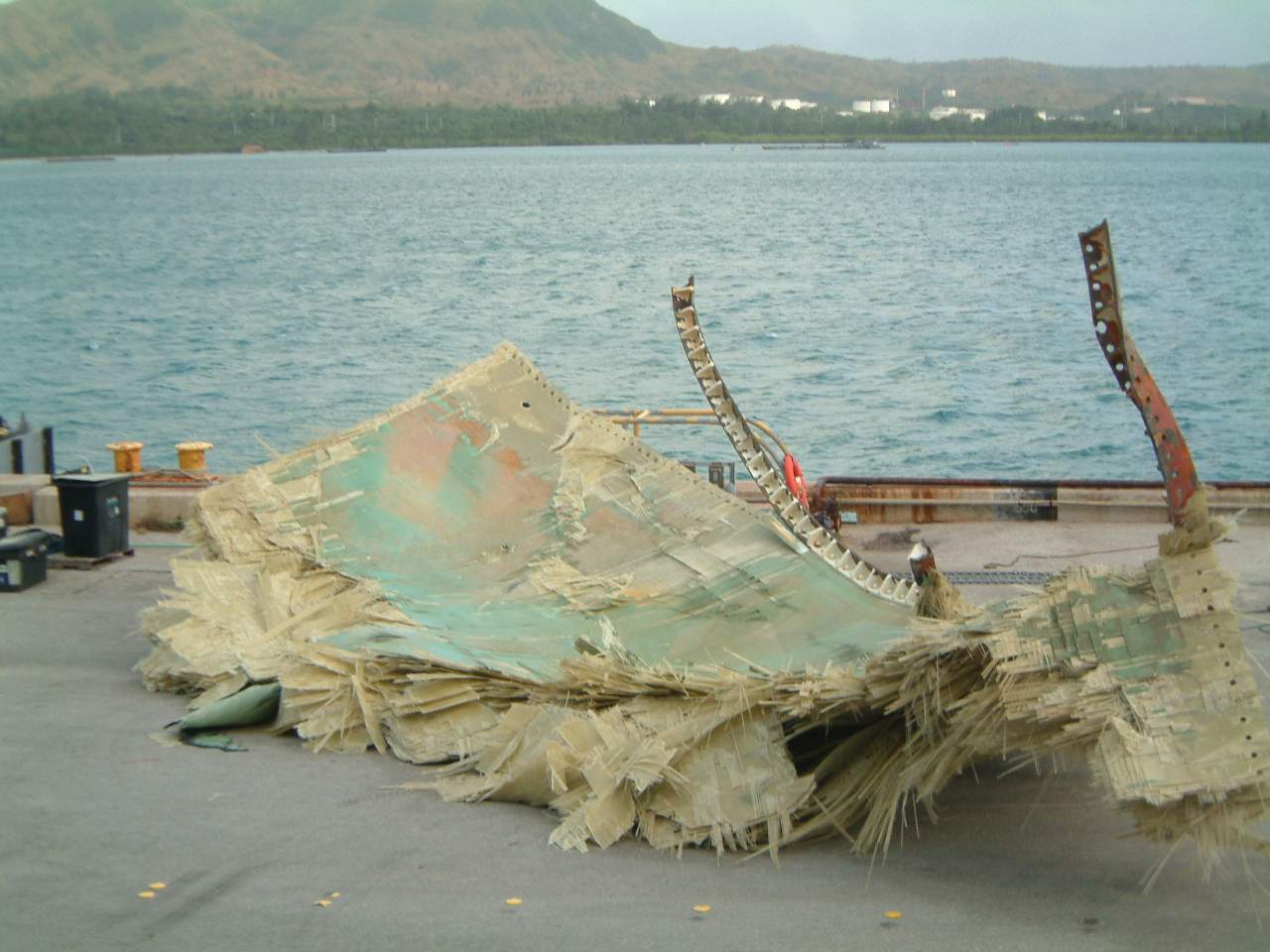
Speaking of pictures, one that I discussed in my entry here is also available for download on the NavSource Online San Francisco page. Other pics of the boat are also available there, including an interesting one that may be of the GRP sonar dome that was removed from the boat (although it looks like it might be a little small, diameter-wise, to be that).

Staying at PD...

Update: From Ron Martini's Submarine BBS, here's a link to a picture of the drydock the San Fran is apparently in.

Update 0122 27 Jan: This report from KUAM Guam says the Navy has released a video of the San Francisco in drydock, showing the damage to the bow. I haven't found a link to the video yet, but I'll post it when I find it.

Bell-ringer 0811 27 Jan: From the comments -- link to video: kuam.com, click on webstreaming, click on 27 january news, and watch the newscast. The video is well into the newscast, about the 3 or 4th story.

Picture of San Francisco in Drydock

Originally posted 1317 27 Jan:

Here at last is the officially released picture of the San Francisco in drydock. I'll need to take a closer look at this later to see what I can figure out, but for now, all I can say is "Wow"... it's an even more impressive indication of the professional seamanship demonstrated by the San Francisco Captain and crew in getting her back home.

Update 1701 27 Jan: Some of my thoughts on the damage are in the comments. Here's another picture from the official Navy site; this one shows the view from the drydock floor. Click on the "Download HiRes" option for an even closer view.

Update 2245 27 Jan: Here's some more coverage of the release of the photos from CNN and the New York Times (registration will likely be required soon). The NYT article has one piece of information that I hadn't seen before:

"Also yesterday, Kent D. Lee, the chief executive of East View Cartographic Inc., a map company based in Minneapolis, said Russian Navy charts indicate more hazards in that part of the ocean than were on the American charts, though they also fail to show the undersea mountain.
"Mr. Lee said the Russian charts have been available for five years. He said one of the Russian charts noted that the area where the crash occurred had been "insufficiently surveyed." It also warned: "Cautionary measures should be taken when sailing."

Going deep...

SubManDave on the San Francisco Grounding

Originally posted 2240 02 Feb:

Submandave provides his take on the USS San Francisco grounding in the form of a Q and A that you should check out. I realize that I should have done that a while ago; I forget that some of my readers might not be submariners. While you're over there, check out the rest of submandave's blog.

In other submarine news, here's an amusing little story from a local Australian paper about a sub surfacing off their coast (probably near Warrnambool, in Victoria) to do a perstrans (personnel transfer). Not sure which sub it is, but it's an Australian Collins-class boat, like HMAS Collins, shown here.

Update 1554 03 Feb: The Herald Sun article confirms that the sub sighted off Victoria was Australian. I'm not sure there was much doubt to start that this was the case, but I guess it's nice to have it confirmed.

Coming attraction: This post by Ninme got me thinking about all that Poland has done for us in the Global War on Terror. I worked very closely with the Poles and their contingent in Iraq when I was stationed at the Coalition Coordination Center at US CENTCOM, and I'm frustrated that more people aren't aware of how they've really gone the extra mile as our allies, and how I think we could do more to show our appreciation. Expect an entry in the next few days.

Edited to remove a stupid update about how I thought my blog was broken because my cat walked across the keyboard when I was making an entry; she actually just changed the font size setting on my browser. I know, I'm an idiot... On the other hand, I did figure out how to get a blogroll started; I'll work on that probably tomorrow. While I'm here, I suppose I should thank all the visitors that tonight took me over 20,000 total page views since I started the blog. Thanks!

Update 2346 02 Feb: Checking E-mail just before hitting the rack, I found my weekly missive from Military.com. Included was a link to an article by Joe Buff containing his thoughts on possible lessons learned from the San Francisco grounding. I didn't read it too closely, except to see a suggestion that sub crews should possibly be provided with crash helmets to wear during high-speed runs. My initial reaction was not positive, but I figured I'd leave it to the overnight crew to see if there was maybe something good in the article. The comments are open...

Damn, This Guy Won't Quit!

Originally posted 0724 06 Feb:

Lt. Raymond Perry, USN (Ret.) of Soldiers For The Truth is at it again. Earlier, I discussed the quality of his reporting on the USS San Francisco grounding, and not only found it to be wanting, but determined that Perry was approaching asshattedness. (Asshat: someone who wears their own ass as a hat.)

In his latest article posted at sftt.org, titled "The 'Navigator's Paradox' "Raymond Perry, USN (Ret.) has not only crossed that line, but tripped over it and fallen flat on his face. Here are some excerpts:

"An article by Christopher Drew in The New York Times last week contained one intriguing piece of information: An attached chart depicted the probable location of the submarine farther west than the optimum track of a fast transit from its home port in Guam to its planned destination in Brisbane, Australia.
"If confirmed, another question arises: Was this position determined by the presence of a senior officer onboard for some reason? Was he to be disembarked on one of the islands of the Federated States of Micronesia for a return flight to his home base, while the San Francisco then continued on toward its planned liberty port of Brisbane?
"Who was this officer? A close review of the numerous Navy press releases and other communications concerning the San Francisco revealed the names of many officers who would be reasonably associated with the San Francisco, but the presence of one officer has gone completely unmentioned: Commander, Submarine Group Seven.
"More questions emerge: Why the silence? Was he on board? Did he drive the thinking of the San Francisco’s skipper and navigator? Did they cut a few corners in order to deliver him to a planned flight home? Did these dedicated officers unwittingly attribute to their charts an inappropriate accuracy that allowed them to deliver on a tight schedule?"

The officer Lt. Raymond Perry, USN (Ret.) is accusing of being on board, with no real evidence, is RADM David Gove, Commander, Submarine Group SEVEN. (On the CSG7 webpage, click on "The Admiral" for Rear Admiral Gove's biography.) Perry continues to intimate that a "senior officer" may have been on board, although he no longer attributes this to "reliable sources". As I stated earlier, my "frequently drunken sources" say that this was not the case. Perry really is a one-trick pony-- he's convinced himself that submarines only have problems because there are senior officers on board. Maybe the reason that RADM Gove is not making a lot of noise in the press is that he is the first Flag Officer in the San Francisco's chain of command, and as such will likely be the Court Martial convening authority. Maybe he's just trying to maintain some public perception of impartiality. Do you think that might be a more reasonable explanation?

Here's the next piece of proof that Perry's sphincter muscle is wrapped tightly around his forehead; the new article claims that the position of the submarine is "west of the optimum track for a fast transit to Brisbane". It wonders if this senior officer was to be disembarked on one of the Micronesian islands to return home (hopefully one with an airport). Well, Lt. Raymond Perry, USN (Ret.), I think you're kind of reaching there. Why not get the free trip to Australia while you're on the boat? I won't go too much into it, but submarines do travel on a track given to them by a higher authority; it's part of something called "waterspace management". This seems to be Perry's train of thought: San Francisco was further west than they should have been! They'd be wasting fuel! Well, Lt. Perry, unlike the ships you're familiar with, submarines don't need to refuel but once every 20 years or so, and San Fran's got a pretty full tank. Maybe for Lt. Perry's next article, he'll find out that Sub Group 7 is the waterspace management authority for the Western Pacific (they are) and figure that the track assigned to San Francisco was approved by people working for RADM Gove (it was). This will be more proof of a great Govian conspiracy! He was probably in the pay of the Chinese! The San Francisco grounding was a plot to distract the people from problems in Iraq!

I'll probably edit this later with more hyperlinks and examples of Perry's fuzzy thinking. When I do, though, I doubt that it will change my final assessment: Lt. Raymond Perry, USN (Ret.), you, sir, are an asshat when it comes to writing about submarines.

Update: WillyShake at Unconsidered Trifles has a suggestion to help me avoid the "bad word" controversy brewing in the comments. (To ensure there's no confusion: SubBasket is my wife, and her comment was meant to be humorous - except for the new basket part. I'm just glad she didn't see what I had to say about the Democratic Underground DUmmies in this post.)

Update 2136 06 Feb: Edited to correct misspelling, punctuation, add a sentence to the update above to make it funnier, and amend one sentence to make my point clearer. I was just about to amend the portion on waterspace management issues to more clearly dismantle Perry's mistaken assumptions, but realized that I might be approaching the bounds of security classification issues if I did. (Since Perry seems to operate in the world of make-believe, he doesn't have this concern.) Also, I figured out something else that bothered me about the article. In the earlier, more sleep-inducing part of the article that discussed navigation techniques (which reached conclusions that were, in my opinion, just plain wrong), Perry's whole tone seems to be along the lines of, "They aren't doing navigation the exact same way I learned to do it 20+ years ago! Because I learned to do it a certain way, any other way is wrong, despite any technological advances." So, in addition to being an asshat, he seems to be something of a Luddite. I'm surprised he didn't complain that the San Francisco crew didn't know how to use a sextant.

Anyway, since sftt.org still has a link to me, I figure he may see this (and I'm also thinking about writing him). I renew my invitation to Perry to provide me with any additional information he has to back up his conclusions, including any additional information he has on the supposed presence of RADM Gove on board the San Francisco, and I'll publish it without editing. I'll still rip the hell out of anything that smells foolish, though. Remember, Lt. Raymond Perry, USN (Ret.), sometimes good people, like the Captain and crew of the San Francisco, can follow all the rules and still have bad things happen to them. It's called "life", and it's not some grand conspiracy (theological implications notwithstanding)...

My E-mail to Lt. Raymond Perry, USN (Ret.)

Originally posted 0929 07 Feb:

In my entry below, I discuss my continuing displeasure with the articles on the USS San Francisco (SSN-711) grounding by Raymond Perry. Eagle1 had pointed out that Perry may simply be a victim of "simple stupidity coupled by with an overwrought imagination", but an E-mail I got from a San Francisco crew member strengthened my resolve, and encouraged me to try to get Perry's fallacies retracted. Armed with additional information sent in by people who know the truth, I decided to E-mail Perry and invite him to respond to my criticisms. Here's what I wrote:

Mr. Perry,
I just wanted to drop you a line and let you know that while I generally enjoy your writing on non-submarine topics, I've been very disappointed in your writing on the USS San Francisco grounding. Your apparent need to tie the root cause back into the recent accidents where there was a senior rider onboard the subs has caused you to lose whatever credibility you might have with me on this subject. Although you mention that "reliable sources" indicate that there was a senior rider on board, going so far as to postulate that RADM Gove may have been that rider, you should have received enough feedback by now to know that this is just plain untrue.
As a professional journalist, you're probably used to getting E-mail from disgruntled readers about your articles, and may just put them in the circular file. However, I write a little submarine-themed blog titled "The Stupid Shall Be Punished" at http://bubbleheads.blogspot.com/ that your web site, sftt.org, has actually linked to. I've been getting about 250-300 hits a day since the San Francisco grounding, and those numbers surprisingly aren't going down that much, so I may have a little bit of a continuing readership. Some of my commenters have indicated that they are displeased with your articles, and you may have received E-mail from some of them. In my blog, I have made a couple of entries dissecting your articles, and have offered you the chance to respond. I wouldn't expect that a journalist of your stature would normally stoop to respond to a lowly blogger, but I felt I needed to make the offer. I also wanted to let you know that I am very confident in my sources who say there was no senior rider onboard, and if you continue to print that there was, I will continue to ridicule your assumptions in my little blog. However, if you would like to withdraw your accusation (yes, I know it's phrased as a seemingly innocent "what if" question, but I think we all know where you're going with it) and try to put out the actual truth, which is that we should honor the professionalism and camaraderie of the San Francisco crew in getting their damaged ship back to port, I'll withdraw the juvenile name-calling I've engaged in. There may in fact be lessons learned that the Submarine Force can apply from this grounding regarding operational restrictions in poorly-charted areas. If you are truly interested in the truth, I urge you to focus on these areas, rather than the non-existent link to phantom senior riders.
Respectfully,
Joel Kennedy -- "Bubblehead"
Also a retired mustang officer, but with no need to put my rank in my signature line.

Okay, so some of the sentences run on quite a bit, but I've always said I'm not an English major; hopefully my point comes through. We'll see if he responds. I'll keep you updated.

Staying at PD...

The Last Word on San Francisco Conspiracy Theories

Originally posted 1335 07 Feb:

This post at Ron Martini's Submarine BBS, from a person I happen to know is a crewman on the San Francisco, should put to rest any further questions on whether or not the San Fran hit another submarine, or if there was an officer senior to the CO on board. As you see from this excerpt, the answers are "no" and "no".

"We did not hit another submerged unit, it was not steel or hull tile we pulled out of our superstructure, it was ROCK, not even coral. We did not have a more senior officer to our Captain onboard, no matter what else you have read on other sites with writers trying to make names for themselves..."

Read the whole post, and remember that this whole episode should be about remembering the sacrifice of MM2(SS) Joseph Ashley, honoring the bravery and professionalism of the Captain and crew, and letting the Submarine Force determine if there are lessons learned that can prevent a recurrence of this tragedy. I'll continue trying to correct anyone on the Internet who says otherwise, but will try to avoid making any further suppositions on the causes or potential outcomes of the investigation on my own (which I admit I have done in the past).

Going deep...

Argghhh! Discusses the San Fran Grounding

Originally posted 2209 08 Feb:

Over at the excellent mil-blog Arrgghhh! they have a post up summarizing their thoughts on the San Francisco grounding and subsequent fallout.

Update 1515 08 Feb: As part of my continuing effort to learn about manipulating my blog, I've hidden the comments for this post, for no apparent reason.

Update 1821 08 Feb: In order to answer Ninme's concerns of a vast government cover-up, I've restored the comments. Nothing's been changed... really... you can trust me... ignore those three deleted comments... just typos and such. Actually, if you're really concerned, you can E-mail me and I'll tell you what happened, or you can go to the revised entry at Arrgghhh! and probably figure it out for yourself...

San Francisco CO Permanently Relieved of Command

Originally posted 2250 11 Feb:

According to this press release from Commander Seventh Fleet, CDR Kevin Mooney, CO San Francisco during her recent grounding, has been officially relieved of command and issued a Letter of Reprimand following non-judicial punishment ("Admiral's Mast") on Saturday, Feb. 12 at Seventh Fleet HQ in Yokosuka, Japan. The report goes on to say:

"Following the submarine striking an underwater seamount Jan. 8, (commander of U.S. Seventh Fleet, Vice Adm. Jonathan W.) Greenert reassigned Mooney to the staff of Commander, Submarine Squadron 15, based in Guam. During the conduct of the investigation into this incident, it became clear to Greenert that several critical navigational and voyage planning procedures were not being implemented aboard San Francisco. By not ensuring these standard procedures were followed, Mooney hazarded his vessel. "

The statement "hazarded his vessel" seems to imply that CDR Mooney was charged with violation of Article 110(b) of the Uniform Code of Military Justice, Improper (Negligent) Hazarding of Vessel. By disposing of the matter at Non-judicial Punishment, the Navy has decided not to court-martial Captain Mooney. Another report of this action, with updated information on the San Francisco herself, can be found on the Navy Times website. This article explains:

"The Navy also announced Saturday that while no decision has been made about whether to repair or decommission the 23-year-old Los Angeles-class submarine, the damage is so extensive that officials have decided to temporarily repair it and sail the sub off the island to a nuclear-capable shipyard in the United States, where a more detailed assessment can be made.
"The temporary repairs will take about three months and will allow the sub, now resting in a Guam drydock, to transit the ocean, said Lt. Cmdr. Jeff Davis, spokesman for the Pacific Fleet Submarine Force in Hawaii. The trip will likely take place this summer, he said.The crew, meanwhile, will remain in limbo on Guam until officials decide the submarine’s fate, Davis said."

While this action was not unexpected, and while I haven't seen the official investigation report (and I'm not likely to), I will be very disappointed if it turns out that CDR Mooney was relieved for taking actions that are common throughout the fast attack fleet. (The crowd over at Ron Martini's BBS is also discussing their feelings about this news.) "Drawing the short straw", or coming up on the wrong side of the odds when operating under the "big ocean, little ship" theory that's common among submarine COs seems to me to be the wrong reason to end an officer's career. It remains to be seen how this action will change the operating habits of the submarine force as a whole. In the early days of WWII, many of the peacetime submarine commanders were too timid to take the fight to the enemy. The result, according to this excellent article from Undersea Warfare, was as follows:

"Our relatively poor submarine performance early in the war was due to a number of factors. First – as in the opening phase of any conflict – gaining combat experience, shedding peacetime attitudes, and winnowing out “less-aggressive” and tactically-inept commanding officers took months of actual fighting."

I only hope that in taking this action against CDR Mooney, the Submarine Force leadership isn't encouraging excessive caution in peacetime that could not easily be cast aside in the event of war. I was always taught that the submarine force should "train like it fights". While I welcome any changes to operating procedures that would reduce the chance of another tragedy like that on the San Francisco, we must recognize that it is impossible to remove all elements of danger from submarining, and I hope we don't lose combat effectiveness by trying to do so.

Staying at PD...

Update 1027 12 Feb: Thoughts on this from some of the other sub-bloggers can be found here and here.

This CBS News report, written before the Admiral's Mast, contains one obvious fallacy, which makes me less likely to believe one potential piece of new information contained in the article.

First, the fallacy: "Normally, a sub relies on its sonar to detect underwater obstacles, sending out pulses of sound and listening for an echo. But the sonar is useless at high speeds because all other sounds are drowned out by the noise the sub makes..."

The truth is that only in very rare situations, such as transiting the Bering Straits to get to the Arctic Ocean, will a submarine use active sonar as a topographical tool. The rest of the time submarines rely on charted water depths and the fathometer (which I guess is a form of active sonar, but not useless at high speeds).

The potentially new piece of information, which contradicts what I've heard elsewhere, is this:

"... before the San Francisco began its high speed run, the crew took depth soundings, which revealed the water was shallower than shown on the chart — another warning sign the captain apparently failed to heed."

I had heard from various "frequently drunken sources" that the sounding taken just minutes before the collision had agreed with the charted water depth; perhaps the investigating team decided to apply a stricter standard to what constitutes a sounding that "checks with charted" than is normally used. Since I would be surprised if anything other than an unclassified executive summary of the accident investigation will ever be released, it's possible that those of us who are limited to printing unclassified information may never be able to determine what really caused the grounding. What I can determine, though, is that Captain Mooney and the crew of the San Francisco represented the Submarine Force with honor, and that their bravery and skill in dealing with the collision and its aftermath should never be doubted.

Robert Hamilton of the New London Day has an article on the CDR Mooney firing (will require free registration after one day) that has this statement that I believe everyone needs to keep in mind:

"The news stunned several Navy sources who have been following the accident investigation, particularly because Mooney's actions after the accident were characterized as heroic by everyone familiar with the situation. Despite extensive damage to the ship, he and his crew got it to the surface and kept it floating long enough to limp back to its homeport of Apra Harbor, Guam."

Whether CDR Mooney and his crew really did make mistakes in navigation planning and risk assessment, or if this is just a case of punishing the Captain just because tradition requires that he be punished, is still to be determined IMHO.

Personal Thoughts on the SF Situation

Originally posted 2151 12 Feb:

Here's a link to a Navy Times article on the NJP for Captain Mooney that doesn't have any new information, but captures what has been in the other articles I've linked (including stuff in the article from The Day that will require registration starting tomorrow). It does have one mistake, though: It's description of a "moving haven" as "an underwater passageway thought to be free and clear of obstacles" is not accurate; however, a quick Google search for submarine "moving haven" didn't show anything that had a good unclassified description, so I guess I can't correct them here. If you'd like to see the messages from Admiral Sullivan referred to in the story, click here.

Personally, I've thought a lot today about the Navy's decision to punish CDR Mooney. The investigating team clearly went through all the boats procedures and records with a fine tooth comb, and apparently found some inconsistencies and practices not exactly in accordance with approved procedures. My unsolicited advice to the Submarine Force brass is to ask themselves: What percentage of the boats in the fleet, if subjected to a similar inspection, would have had similar deficiencies? I would suggest that if the number is greater than a few, they should reconsider whether or not they want to punish more of the crew (as was done in most recent accidents, including the Greeneville and Oklahoma City collisions and Hartford grounding*), or if they should concentrate more on solving a potentially force-wide problem. Of course, if they did that, they may have to admit that the current inspection teams, which work for the senior commanders, maybe hadn't been looking for the right things.

* I couldn't find a convenient link directly to the Hartford grounding NJP story, so I reproduce a portion of it from this link below (full story about 3/4 of the way down):

Skipper, Squadron Commander Relieved; Six Others Disciplined In Sub Grounding In The Mediterranean
By Robert A. Hamilton, New London Day 11/10/2003 (Used with permission)
The captain of the Groton-based USS Hartford and the squadron commander who was aboard the submarine when it grounded off Sardinia last month have been removed from duty after the admiral in charge of submarines in the Mediterranean "lost confidence in their ability to command," a Navy spokeswoman said. Six other Hartford crewmen were charged with dereliction of duty and punished over the weekend, including one officer and one enlisted man who were relieved of their duties and ordered back to Submarine Squadron Four at the Naval Submarine Base in Groton.
Cmdr. Christopher R. Van Metre, captain of the Hartford, and Capt. Greg Parker, commodore of Submarine Squadron 22, will also return to the United States, said Cmdr. Cate Mueller, a spokeswoman for the Sixth Fleet in Gaeta, Italy. "There is the possibility of follow-on actions involving both officers," Mueller said. They were relieved from command before any formal proceedings because the Group 8 commander, Rear Adm. P. Stephen Stanley, "no longer had confidence in their ability to command."

Staying at PD...

Update 0202 13 Feb: Here's the report on the Admiral's Mast from KUAM, a local Guam television station. This report includes some discussion of the on-going repair work, including this bit:

"...the Navy is planning to make temporary repairs to the bow of the San Francisco so she has adequate structural integrity and proper buoyancy for transit under her own power to a shipyard, which is yet to be determined, with comprehensive repair capabilities. These temporary repairs will be engineered to ensure a successful transit. As part of having on-hand materials for potential use in these temporary repairs, a large steel dome about 20' high and 20' in diameter will be arriving on Guam in the next few days."

I'm assuming this "large steel dome" is a metal sonar dome, of the type submarines used to use before they came up with the glass-reinforced plastic replacements. (If this link is bad, go to this page; the picture of the San Fran's shredded sonar dome is currently the 13th picture down.

Note: While looking for a better link to a GRP sonar dome than the link above, I stumbled across this USNI web page on Los Angeles Class submarines. It has a nice interactive display of a submarine, where if you roll your mouse over various parts of the boat, it shows you what's inside. A good resource for the non-submariner.

Update 2332 13 Feb: Fellow submariner Rob posts his thoughts on the San Francisco.

Parents of San Francisco Sailors Speak Up

Originally posted 2334 13 Feb:

A San Francisco crewman's parent wrote to tell me that their son has expressed continued faith in Captain Mooney and his abilities. This, more than anything else, tells me how highly the crew thought of their Captain -- that even after he's been relieved, the crew is willing to stand by him.Over at Ron Martini's Submarine BBS, the father of fallen submariner Joseph Ashley shares a letter he and his wife wrote to CDR Mooney. Please take the time to read it, and if you haven't already, please leave your thoughts for Mr. and Mrs. Ashley at the Akron Beacon-Journal website.

Going deep...

SFTT Writer E-mail Response Watch -- Day 7

Originally posted 0904 14 Feb:

Seeing that my previous E-mail to Lt. Raymond Perry, USN (Ret.) has gone unanswered for seven days, I today sent a follow-up, as follows:

Mr. Perry,
I had written you last Monday with some questions about your coverage of the San Francisco grounding, particularly your assertion that some mythical "senior officer" rider had changed the ship's normal operational routine. My earlier E-mail is attached, with the body copied below. I understand you are busy, but some of my commenters have mentioned that you have found time to write short replies to their E-mails to you. I just wanted to make sure that you had gotten my E-mail. If you are too busy to reply due to working on a follow-up article about CDR Mooney's NJP, and would just like to withdraw your baseless and unfair accusations that CDR Mooney was "intimidated" by or was "showboating" for this non-existent rider, simply so state in your follow-up article, and I will consider this a satisfactory reply.
Respectfully,
Joel Kennedy, also a retired Navy Officer

My discussions on Perry's previous articles are located here and here.

Staying at PD...

Mooney Supporters Race to His Defense

Originally posted 0842 15 Feb:

This is the title of an article by Robert Hamilton in The New London Day (annoying free registration required after 1 day; a more long-lasting non-registration version can be found here, 2nd story down). In addition to being interesting because it quotes many of the active posters on Ron Martini's Submarine BBS, it has the following information from MM2(SS) Joseph Ashley's father, and provides an indication that the backlash against the Submarine Force's decision may be growing:

“How could I in my right mind hold him responsible? No one has showed me yet that he did anything wrong,” said Daniel Ashley, the parent of Machinist Mate 2nd Class Joseph Ashley. “I'm just having a difficult time justifying in my mind that he is to blame here.”
"Ashley said he is upset that satellite images of the area taken in 1999 show the seamount, but that information was never incorporated into Navy charts. He said the Pentagon needs a process to get the most updated information into Navy charts.
“The crew jumped through all the hoops, they took all the soundings, they did everything they should have done,” Ashley said. “The captain tried to apologize when we went out to Guam last month and I told him he had nothing to apologize for.”
"That same sentiment has been expressed by many in the submarine community, and is spreading quickly on computer bulletin boards and e-mails."

Staying at PD...

Chapomatic is Back...

Originally posted 1914 15 Feb:

...and blogging up a storm. I count 13 separate posts in a 15 minute period; I think he's been saving up. All of the posts are interesting, and well worth your time (especially his Link Dump), but the two that I think most apply to submarines (because they mention me) are Chap's take on the firing of CDR Mooney of the San Francisco, and his well-written post on Soldiers For The Truth, which unlike my critiques, does not stoop to calling SFTT writers "asshats".

San Francisco Temporary Repairs

Originally posted 2232 16 Feb:

An article in Stars and Stripes has some information on the ongoing repairs to USS San Francisco. It appears that a temporary dome will be welded to the pressure hull in the bow; this dome, which will be watertight and filled with air, will provide the necessary buoyancy for the sub to make a surfaced transit across the Pacific. Excerpt:

"Repair teams will attach the dome, repair the ballast tanks “and do all the things necessary to make it safe to navigate on the surface,” Davis said.
"Though no decisions have been made about when the sub will depart Guam or where it will go, Davis said, “we think the temporary repairs will take three months.” The transit probably will occur this summer, he estimated."

This makes sense, as long as by "repair the ballast tanks" they mean they will cut away any portions that would interfere with the installation of the dome; I think repairing the forward port ballast tanks will be a little too much for the Guam shipyard to handle...

60 Minutes and USS San Francisco

Originally posted 2229 02 March:

From Ron Martini's Submarine BBS, a post from the father of the Sailor who died on the USS San Francisco says that 60 Minutes may be preparing a story on the grounding. It'll be interesting to see how this evolves, and if they'll focus on the skill of the crew, or go for the sensational. I know which direction I'm leaning...

Going deep...

[Here's my post about the story that eventually ran on 60 Minutes.]

Copyright Law and Brave Men

Originally posted 0934 09 March:

Over on Ron Martini's BBS, we find a story that looks like another case of the media vs. the little guy, but in this case, the "little guy" is just about the toughest A-ganger I know, and he's not taking it lying down:

"Aight, I do not like to post this, but I am being hunted by a reporter from the above said organization [Navy Times]. It seems a letter I posted on Goatlocker.org, a private BBS for Chiefs, was leaked to blogs, and now this reporter wants to use all of the online letters from US, PROUD submariners, to sell papers in a future navytimes paper about the San Fran.
"Fellas, that really gets my goad, and I don't like it. I already have friends checking on the legality of it. The letter I wrote was just days after the grounding and very emotional in nature, and I do not want it published on paper for somebody to market or make money on. I need you shipmates to help me and email the editor at navytimes and stop this BS. I posted that letter to my shipmates to let them understand what and how bad a severe casualty could do to even the highest trained people on the submarine.
"I might lose this fight, and my letter be published, but I will not support it. What I need is the support of other people to email them and let them know that we won't put up with it.
"The leaked letter? Hahaha, here it is, a uncut version that was explained by an ex submariner. Click the link, and you will see my thoughts."
hagar
San Fran Diving Officer

"Hagar" is the nom de plume of the submariner who was the Diving Officer of the Watch on USS San Francisco (SSN 711) during her recent collision. I'll write more on this later, but for now, please write the Navy Times by clicking here and leaving feedback.

Update 1314 09 March: As I was researching the applicable copyrights laws that Hagar might be able to use in an effort to prevent publication, I found this piece over at Legal Database. (As I checked back at Martini's BBS, someone else had also found it, so I could have saved myself some Googling.) The relevent portion:

"Works put on the Internet are considered “published” and therefore qualify for copyright protection. A work put on the Internet is not considered public domain simply because it was posted on the Internet and free for anyone to download and copy. You need permission from the site owner to publish any materials, including photographs, music, and artwork from the site.
"The best way to enforce Internet copyright is through the Digital Millennium Copyright Act. The Digital Millennium Copyright Act of 1998 is designed primarily to limit the liability of Internet service providers for acts of copyright infringement by customers who are using the providers' systems or networks..."

So, it would seem that Hagar's work is protected by copyright. This wouldn't protect him from having The Navy Times print a "fair use" portion of it if they attributed it to him, but I think it could keep them from printing the whole thing. I'd be interested to hear what any law-bloggers might have to say about this. Eagle1, how copy?

Staying at PD...

NYT Article on USS San Francisco

Originally posted 2209 12 March:

(Intel Source: The Sub Report) It looks like the Navy is going on the offensive against perceptions that CDR Mooney of the San Francisco was punished for no reason. The New York Times has this article in tomorrow's paper (registration required) that has as it's sources "Navy officials" who gave interviews this week. Excerpt:

"Navy investigators have found that the officers on a nuclear submarine failed to take into account a variety of danger signs before the vessel smashed into an undersea mountain in January, Navy officials said in interviews last week.
"The officials said crew members on the submarine, the San Francisco, did not look at some navigational charts of the South Pacific that might have prompted more caution. The sailors also should have checked the water depth more frequently and should not have been traveling at high speed, the officials said."

Interesting. Hopefully one of these "officials" mis-spoke when saying that they should have paid more attention to South Pacific charts, since all indications are that the collision happened over 450 miles from the South Pacific... it'd be fairly ridiculous to hold all boats responsible for any weird chart readings within 500 nm. It's also interesting that they say that they should have taken more frequent soundings, and shouldn't have been going so fast. I'll be watching to see if they say they just shouldn't have been going so fast in general due to nearness to potential shoal water/minimal sounding data, or if this is related to whatever soundings beneath the keel they may have received before the grounding. While I recognize that the Navy's actions in firing CDR Mooney were probably necessary simply because of tradition, I still say that CDR Mooney just came up on the wrong side of the "big ocean, little ship" odds, and would venture that most fast boat skippers would have been operating the same way in the same situation.

Staying at PD...

Update 0849 13 March: Here's a longer version of the same article that doesn't require registration.

Navy Times Articles on USS San Francisco

Originally posted 2232 15 March:

As I discussed earlier, the Navy Times printed some excerpts from E-mails from crewmen assigned to the San Francisco, in at least one case against that Sailor's wishes. The article that discusses the first-hand accounts is here. Since the Navy Times is all about "fair use" excerpts, here's mine:

"Leaning against the ship’s control panel, one hand clutching a hand grip, Hager was busy changing the expected soundings for a new depth on his charts. The ship had just moved into deeper water.
"And then it happened. A submariner’s worst nightmare became reality: undersea collision.
"Hager plowed headfirst into the control panel, punching his palm through a thick Plexiglas gauge. His leg was crushed after the quartermaster of the watch rammed into Hager’s chair, sending it “flying more than 15 feet,” and pinning Hager’s leg against a hydraulic valve and the control panel.
"In his e-mail, obtained and verified by Navy Times, Hager described the force of the impact in layman’s terms. Imagine a recreational vehicle full of people slamming into a concrete wall at about 40 mph, he said, and then trying “to drive the damn thing home” while dealing with serious casualties."

All in all, I'd say that it sounds like a pretty good article, and fair to the crew as well. While I don't like the fact that the Navy Times used what was meant to be a personal communication with the Chief's community against the will of the author, I'm glad they didn't turn it into some sort of hatchet job. The main thing that I've taken away from the grounding was the high state of training and professionalism of the crew in getting their crippled ship home, and the obvious brotherly love that they've all shown towards MM2 (SS) Joseph Ashley and his family. The other article is excerpts from the E-mails sent out by SubPac immediately after the collision that have been discussed elsewhere many times before.

Going deep...

Other Shoe About To Drop

Originally posted 2150 16 March:

From what I've been hearing through the grapevine, and from what is spoken about openly here, it looks like the Sub Force is about to dole out punishment to more San Francisco Sailors for their actions leading up to the recent grounding. Interestingly, it looks like they'll do that before they give out the awards for saving the ship to other crew members. I wonder what they'll do if there are Sailors who should get awards but are up on charges? I'd like to say I have faith in the powers-that-be to do the right thing, but right now I'm not too confident...

Staying at PD...

Commodore's Masts

Originally posted 0534 22 March:

It sounds like they're done with the Commodore's Masts for the San Francisco. With previous subs that have gotten into trouble (Greeneville, OKC) the Navy has announced in general that other officers and enlisted men were punished without listing the specific charges and "awards". Therefore, you won't hear it first from me, either. I have heard that the San Fran will have an awards ceremony on Friday, so we'll see if any of the punished Sailors also get awards; I would certainly hope they would if they're deserved...

Staying at PD...

Update 1825 22 March: Here's the Navy Times story on the Masts. Excerpt:

"...reliable sources told Navy Times that those punished included the heavily damaged submarine’s executive officer, navigator, assistant navigator and three petty officers. The assistant navigator is a senior chief petty officer who had qualified for that duty. Sources also said that the three more junior sailors reportedly each lost a stripe, with one first class petty officer reduced to second class and two second classes reduced to third.
"The Navy has not yet released any of its investigations into the mishap but given the initial punishments, it appears that much of the blame has been placed on the submarine’s voyage planning process. In Mooney’s case, Greenert concluded, according to a spokesman, that “several critical navigational and voyage planning procedures were not being implemented aboard San Francisco. By not ensuring these standard procedures were followed, Mooney hazarded his vessel.”
"Once a submarine’s superior command orders a sub to deploy and issues a basic track or operating area, the sub’s navigation team is totally responsible for properly planning the route, according to U.S. Submarine Forces in Norfolk. The actual charts and plan are prepared and approved by, in order, the sub’s assistant navigator, navigator, executive officer and commanding officer, according to the Norfolk command.
"Davis said the Guam command does not anticipate disciplining any other crewmembers as a result of the mishap."

Article on San Francisco NJP

Here's an article by Bob Hamilton of the New London Day (registration required after today) that has some background information on the thinking that may have gone into the Commodore's Masts for the 6 USS San Francisco crew members earlier this week. Excerpts:

"Sources said the sailors were all punished as a result of an administrative proceeding known as a commodore's mast, which lasted 10 minutes or less for each of the men and focused on two areas of inquiry: whether the crew had obtained the most recent charts on board and whether it exercised sufficient caution when there was evidence that the charts being used might be faulty. The executive officer, a lieutenant commander, and the navigator, a lieutenant, received permanent punitive letters of censure, Navy sources said Tuesday.
"The assistant navigator, a senior chief electronics technician, received a similar letter and was stripped of his Navy enlisted classification, which ousts him from the submarine force.Three other enlisted men, all members of the San Francisco navigation team, were demoted one rank, one of them from electronics technician 1st class to electronics technician 2nd class, and two others from 2nd class to 3rd class...
"...The punishments, and the lines of questioning, seem to support claims by Navy sources last month that the submarine had not updated its charts with notices to mariners, some dating back to the 1960s and some made as recently as last year, that would indicate a seamount in an area where the water was supposed to be several thousand feet deep.
"In addition, the same sources said, the navigation crew had taken a sounding that showed the water to be thousands of feet shallower than on the charts. Though still showing ample water under the keel for safe operation, the discrepancy should have prompted more caution, the sources said."

For me, the thing that jumps out is the statement that the boat "had not updated its charts with notices to mariners... dating back to the 1960s". I was taught that when you prepared a chart, you went back through the Notice to Mariners only as far as the date the chart was prepared, it being assumed that the chart contained all applicable Notes up to the date it was printed. If the Submarine Force is in fact expecting that all boats have been updating all charts with all Notices to Mariners back to whatever date, I'm sure that the Tactical Readiness Examination teams have been checking that on each exam. (Note: the previous sentence is sarcastic -- they don't check that.) This just confirms to me that the Sub Force is really reaching here, and this saddens me; in trying to find their way in this new unipolar world, they seem to be falling back on their old habits of shotgun-blasting everyone who is involved in anything that brings negative publicity to the Force. As far as the charge that the soundings they received were significantly different than charted, that is a fairly serious shortcoming, but again one that I believe was shared by many boats in the fleet (not that it's a problem now, of course.) I base this only on the small sample of boats that I've been on -- at a flank bell in deep water, soundings are not as accurate as they are in shallow water and slower speeds. What I would do is keep taking soundings until I got one that matched. If the sub force expects that every boat that was doing a flank bell treat a bad sounding at flank in deep water as basically a yellow sounding (which sounds like what they expected, and which, to be honest, is probably what the letter of the law required) I think they could have done a better job of stressing that if they think now that it is a punishable offense not to do it.

More on this later... Staying at PD...

Bell-ringer 0023 25 March: Here are some comments on the comments to this post over at Chapomatic. Also, Lubber's Line has a post on the next generation of the Submarine Voyage Management System.

Update 0038 25 March: submandave has some thoughts in his own blog as well. [Admin note: This was actually an update to a different post for which all the links had expired, and didn't have any real input from me; therefore, I added it onto this post for the archives.]

USS San Francisco Awards Ceremony

From KUAM Guam, here's the story on the awards ceremony for the San Francisco held today. I can't tell for sure, but I don't see the names of any of the navigation team (the ones who are likely to have been taken to mast earlier in the week) nor did CDR Mooney get an award. In any event, it's nice to see the Navy recognize the bravery of the crew. Shipmates, you make me proud to be a submariner.

Staying at PD...

Update 2100 26 March: Here's a picture from the awards ceremony of the ship's corpsman, HM1(SS) James Akin, receiving the Meritorious Service Medal.

More San Francisco Musings

Discussing the San Francisco grounding at my SubVets meeting today got me thinking about a couple of things. Now I haven’t seen anything official, but I’ve heard enough rumblings on some other boards that it sounds like one of the things they’re holding against the San Fran navigation team is that they didn’t get their movement order early enough. Here’s how it works: submarines get a message from their Operating Authority ordering them to get underway; this message includes their route, average speed, and any exercises they’re supposed to do on their trip. There’s a requirement that the boat receive this message a certain amount of time before the underway, which may not have happened in this situation. From what I’ve seen, and from what I know of the Sub Force, this “passes the smell test” as far as being something that they would come up with to blame the boat for.Assuming this is true, I suppose the boat could have refused to get underway since they didn’t have their movement order in time. How do you think that would have gone down? Do you think the CO would have been recognized for his bravery in standing up for the letter of the law? Show of hands? I didn’t think so…

I don’t know how significant the problem of late-issued movement orders is now, but I can say that I don’t have enough fingers and toes to count the times the movement messages to my boats didn’t reach us within the time limits. Did the Navy go back and find out how many such messages have arrived late at the various boats, and punish the navigation teams involved for not protesting? I would guess the answer to that would be “no”, and I wouldn’t expect the Sub Force to do that. To me, it’s just another example of the San Francisco crew getting punished for doing the same exact thing as every other boat in the fleet.

Ignorant "Strategy Page" Story on San Fran

Originally posted 2020 30 March:

Here's another article in a semi-major web publication that really torques me off. (It doesn't torque me as much as the idiotic articles at sftt.org by Lt. Raymond Perry, USN (Ret), which I discussed here and here; he never did respond to me, btw.) Here's some of what James Dunnigan at Strategy Page has to say about the San Francisco grounding in an article outrageously titled "USS San Francisco Heros (sic) and Villians":

"...The lack of courts martial indicates that the navy didn’t feel it had strong enough evidence for that approach, which is more like a jury trial, and demands more compelling evidence. The non-judicial punishment hurts, but does not destroy, the career of a submariner. This is because the navy has a hard time recruiting qualified people for this kind of work. The accused sailors could have asked for a court martial, but apparently all were convinced that taking the non-judicial punishment would get the matter behind them with a minimum of fuss and penalty. The charges in the non-judicial hearings were of the “you should have seen this coming” and “been more cautious” variety. Anyone who knows anything about nuclear submarines, and their crews, knows that these are the most cautious and deliberate sailors in the fleet..."

Other than the asshattedness of the title, I'm surprised that someone who purports to know about the military would make such an obvious mis-statement of fact in saying that the Sailors could have asked for a court martial. From Art. 15 of the Uniform Code of Military Justice:

(a) Under such regulations as the President may prescribe, and under such additional regulations as may be prescribed by the Secretary concerned, limitations may be placed on the powers granted by this article with respect to the kind and amount of punishment authorized, the categories of commanding officers and warrant officers exercising command authorized to exercise those powers, the applicability of this article to an accused who demands trial by court-martial, and the kinds of courts-martial to which the case may be referred upon such a demand. However, except in the case of a member attached to or embarked in a vessel, punishment may not be imposed upon any member of the armed forces under this article if the member has, before the imposition of such punishment, demanded trial by court-martial in lieu of such punishment.

The San Francisco crewmen were all attached to a vessel, and therefore were not eligible to request a court martial; even if they had, I'm sure the Navy would have denied it. Also, the claim that "the non-judicial punishment hurts, but does not destroy, the career of a submariner." Bullshit! Part of the NJP for the ANAV was apparently the removal of his NEC, which effectively removes him from submarines, and the NJP essentially keeps anyone from getting promoted within the Chief ranks for five years. For the officers, any black mark is enough to keep you from screening for the next level of responsibility, and with the "up or out" policies, this essentially ends their submarine career. I suppose that they could have a career in the Navy outside of submarines, though...

If you'd like, you can comment on Dunnigan's story here...

Staying at PD...

Update 1952 31 March: They've removed the portion of the article about the Sailors being able to request court martial, so the article is now factually more accurate.

Update 2149 31 March: Submandave shares the E-mail he sent to the author of the piece linked above.

San Francisco Chart Preparation

Originally posted 2206 03 Apr:

Lubber's Line has an interesting post up on his thoughts of the chart preparation issue relating to the San Francisco grounding. While I'm sure I don't have much more information than he does, if I had to guess where the charges of "inadequate chart preparation" came from, I'd say that the Navy might be saying that the San Fran didn't use the "most useful" chart available. When planning a voyage, there are actually several charts one can choose from, depending on the area of the world you're transiting; obviously, there will be more available for places like the Mediterranean than other areas.

Choosing which chart to use as your primary planning chart is really more of an art than a science; the Navy doesn't come out and tell you which chart to use. Some charts have lines connecting areas of like depth (isobath lines) while others may have more detailed information on unexploded ordnance, shipwrecks, and the now infamous "discolored water". I know from experience that it's sometimes hard to tell which chart to use; it usually doesn't matter, but in this case it may have. Of course, in retrospect I suppose investigators could decide which chart was better for one given situation, but come on... does choosing the "wrong" chart, which was revealed as wrong only with the benefit of 20/20 hindsight, really rise to the level of a punishable offense?

Update 0958 12 Apr: Lubber's Line has a follow-up post.

Lt.(Ret) Perry Rides Again

Originally posted 0040 06 Apr:

Well, Lt. Raymond Perry USN (Ret), who recently wrote a couple of ridiculous pieces on the San Francisco grounding that I fisked here and here, opened up his pie-hole again about the submarine force. While he doesn't specifically bring up his baseless charges that a senior officer was riding the San Fran, he shows that he's clearly being fitted for a tin-foil asshat with lines like this in his latest article (emphasis mine):

"...More recently, the Navy processed those deemed guilty of grounding the USS San Francisco via Article 15. In this case, the hearing for the former Commanding officer, Cmdr. Kevin Mooney, was held at a time that appears to have been chosen to minimize news coverage.
"Mooney’s Admiral’s Mast (an Article 15 hearing convened by a Navy flag officer) was held on a Saturday morning in Yokosuka, Japan. Given the time zone difference this hearing was effectively held late on a Friday evening in the United States. I believe this was chosen precisely so that the entire weekend would intervene in the modern 24-hour news cycle so that by Monday morning it would be old news.
"Additionally - unlike the admiral’s mast following the Greeneville-Ehime Maru collision - this hearing was held well before the completion of the formal investigation, leading me to wonder if there was a reason that senior Navy leadership wanted this hearing to be well in the past when the investigation was completed and approved."

Normally, I might agree with someone who says that the Navy senior leadership handled the punishments associated with the San Francisco grounding badly, but in the case of Lt. Raymond Perry, USN (Ret.), I just can't do it. Good ol' Ray seems to be saying that CDR Mooney should have been taken to a court martial; this may have given Captain Mooney more of a chance to defend himself, but I don't think that's what Perry was wanting. Also, he never comes out and says it, but I can't help wondering if his belief that the Navy was trying to "cover up" the NJP (which explains the official press release they put out, I guess) was because of his continuing belief in the fictitious "senior rider". I'd write him again, but since he didn't answer last time, I probably won't waste the bandwidth.

Staying at PD...

Update 0059 06 Apr: Darn! I thought I might have invented the term "tin-foil asshat" in the post above, but it turns out it's been used before...

I Print Unsubstantiated Rumors So You Don't Have To

Word on the street is that Christopher Drew, New York Times columnist who writes about submarines and the co-author of Blind Man's Bluff, is calling people in Guam trying to get ahold of the San Francisco crewmembers who were punished for the recent grounding, and may actually fly there to do interviews. While I haven't been a big fan of some of his earlier San Fran coverage, this newest line of questioning, if true, sounds like he might be angling for more of a "Navy leadership threw these men under the train" type of approach, which I would fully support (the coverage, not the Navy actions.)

Staying at PD...

Navy Spinning San Francisco Story

Bob Hamilton of The New London Day, who I really respect, has a long article out on what he's learned from various sources about what the final report on the San Francisco grounding will say. (Registration required starting tomorrow.) Discussion on this article at Ron Martini's BBS can be found here. Excerpt:

"The report, which could be released as early as this month, will cite problems with the USS San Francisco's chart preparation methods and, more seriously, the crew's failures to recognize specific warnings that the submarine was headed into trouble.
"Soundings showed the bottom was more than 1,200 feet shallower than on the charts that were in use, a difference of more than 20 percent, the sources said. In addition, the ship's fathometer showed the water was shoaling, or getting more shallow with each reading, over an extended period of time, the sources said.
"Either one of the warnings should have prompted the crew to slow the submarine down and proceed far more cautiously, the sources said. Instead, the ship plowed into an underwater mountain that was nearly a sheer cliff at a speed of about 30 mph.
"In addition, the navigation team was not laying out the ship's projected track far enough ahead of the ship's actual position to determine whether it was sailing into safe water, a particularly dangerous practice in the island-studded area of the Pacific where the San Francisco was operating, the sources said."

This spin that the Navy's putting out is fairly interesting to me. Earlier, I've intimated that I really don't know any more about this incident than anyone else. In truth, I've been able to glean, based on unclassified information, some of the specifics of the grounding that leads me to believe that the people providing the information to Mr. Hamilton are trying to "spin" it to make it seem as bad for the crew as possible. True, there were some soundings that were shallower than expected, but the sounding immediately before the grounding did check with charted. Boats have bad soundings all the time; did investigators go back in other subs logs to see if all of them turned around, or requested a change to their op order, every time they had a sounding that didn't check with charted? Of course with the benefit of 20/20 hindsight, investigators will find problems with what was done, but they could do that with any boat on any underway. We've heard how the collision will generate a lot of new rules and regulations for boats to follow in navigation. My point, which I will continue to make, is that I believe that the crew did the same things that most boats in the fleet would have done before January. If the mistakes were so "obvious", why didn't the Sub Force do a better examining for boats making similar mistakes earlier? The answer is that they didn't; right or wrong, this same thing could have happened to any other attack boat given the same operational order.
One line in particular from Hamilton's story in particular grabbed me: "In addition, the ship's fathometer showed the water was shoaling, or getting more shallow with each reading, over an extended period of time, the sources said. Either one of the warnings should have prompted the crew to slow the submarine down and proceed far more cautiously, the sources said." Yes, that is true; the problem, or actually non-problem, is that the chart said the water was shoaling, and the crew expected this; accounts we've read from watchstanders indicate that the boat had just changed the limits for the soundings based on moving into deeper water from the previously expected "shallower", shoaling water.
I care a lot about the Submarine Force, and I admit that I'm worried about the direction the Force has been taking for the last few years. While submarines are doing vital work in the prosectution of the Global War on Terror, it seemed that more and more time was being spent preparing for more and more inspections; exams that I honestly didn't see related very much to the real world. Classification issues prevent me from getting too far into the things the boats did, but if a large portion of your time is spent preparing to run drills for things that might only happen every 10,000 boat-years, this takes away from the time you can spend preparing for what is really going on.

Going deep...

Update 0844 10 Apr: Another copy of the article that will last a little longer can be found here.

Update 0955 12 Apr: An even longer lasting copy is over at Submarine Brotherhood.

Analogy

Originally posted 1414 10 Apr:

I got this from a friend intimately involved in the San Francisco situation. It provides some food for thought...

"As I left home yesterday to go to a meeting, I decided to take a longer route based upon the flow of traffic, the 4 lane was generally faster and had less stoplights with the amount of traffic on the road. I chose this although knowing that it had more turnoffs and more traffic, it flowed a little quicker than the 2 lane which could be held up by a single person and no passing on the road. I had to be on time, and I was being pushed by a late appointment that I didn't know until the last minute, but I had near enuf time to make it.
As I left my condo, I looked up as I left the parking garage, yucky, it was intermittant showers, with coral roads, dumb drivers, and traffic, I'd have to watch out for stupid people, but I'd done this many times before, and even at high speeds, my good tires would hold the road like they were designed to do. I didn't travel this other route often, but this time I didn't have a choice, I had a last minute appt. to make because of my boss.
On the 4 lane, the speed limit was 35, and traffic travelling at about 40 mph, not too bad, I was pretty sure that I was gonna make my appt. it was not as bad as I thought. The roads were still wet, but at that speed they were safe as long as I watched out for crappy drivers, this lovely island is rife with single car accidental deaths.
I'd actually made almost 9 of the 12 miles to the appt. when a centerlane car decided to pull out in front of me and cut me off about 3 feet in front of me, I swerved into another driver to the right of me and off the road we went. So, it was a 3 car accident with injuries. We were close to a cliff on the hill, and it could have been so much worse if we had not hung up on the side of the road. I got a ticket for swerving to miss the driver that cut me off, illegal lane change, haha, but I was happy that I was not hospitalized, and laughed at the ticket. The primary driver who pulled out in front of me had no insurance so it will be a civil thing, and here, that means nothing will happen to them. The 3rd driver had no choice, but at least had insurance.

The story?
1. The police investigation gave me a ticket for illegal lane change.
2. The Naval investigation cited:
a. Improper voyage planning, timing was determined against route and undue danger was not taken into proper planning before hand.
b. Supervisor did not request more time prior to planning voyage due to time restraints, should have requested more time to plan.
c. Supervisor chose route with more possiblities of incident, but did not request or perform a better route based upon time restraints, should have been more cautious.
d. Supervisor chose undue speed without thought of weather conditions, traffic patterns, and hazarded himself and vessel.
e. Hazarding a vessel, the Supervisor swerved to avoid an impact, therefore causing a 3rd impact with another underway vessel.
f. Charged with hazarding a vessel based upon the above findings and the vehicle confiscated.

Luckily, this is only a interesting read to think about a few things. Read it, and ponder, and really think about it..."

Crystal Ball

Originally posted 0028 11 Apr:

The news article I discussed in this post has set me to thinking, and here's what I've come up with. For various reasons, the Navy has decided to make "scapegoats" of the navigation team on the San Francisco for their recent grounding. This, as I thought about it, was actually to be expected. The Navy submarine force has to operate within a public perception that they don't do anything wrong. With respect to the nuclear power part of the equation, they're pretty much right. However, we nukes have an old saying: "The reactor's not safe unless the ship is safe." As a result, the Navy can't make it seem that their subs are running around in an unsafe condition, so they have to make it seem that the navigation "errors" on the San Francisco were an anomaly.
In the next few weeks, you can expect the Navy to follow up their "leaking" of summaries of the report to selected reporters (those whose articles are normally printed in the Early Bird) with a public release of sanitized portions of the report; specifically, those parts that make the San Francisco grounding sound like a problem of human error on the part of the crew. I guess I really can't blame them too much for choosing this route; they really don't want the scrutiny from those who don't know what's going on. I'm convinced that the Navy is making the institutional changes that are necessary to prevent similar accidents from happening; at least for as long as Sailors currently in the service are still onboard the boats. Should the careers of seven men be too much to ask?
I, probably naïvely, think that it is. As much as I'd like to think that the submarine force is an important issue to a lot of people, in the big scheme of things, it really isn't. The Navy could have just as easily announced that the grouding was basically due to bad luck, but they were changing their procedures to make luck less on an issue, and most Congresspersons would have bought it. I'm afraid that by making this an issue of "human error" vice incredibly bad luck, the Navy will be teaching future submariners that they shouldn't ever take risks. To be honest, in peacetime that's not a bad idea. The problem is that submarines should be able to go from peace to war with no notice, as they had to do in December 1941. Back then, the Sub Force had skippers that were brought up in the risk-averse era of the 1930, and as a result basically none of the peacetime COs became successful wartime COs. God willing, we won't ever again have a war where risk-taking submarine COs are necessary, but if we do...
I'm really not sure who I'm writing this to. I guess I'm hoping that the crew of the San Fran might see it, and understand a little more why their shipmates are being thrown under the train. I also hope that some active duty people might read this, and decide that when they are running the Sub Force, they'll change our ways of doing business such that you don't have to scapegoat innocent men who were doing their job in the way they were trained. In other discussion boards, I've seen submariners say words to the effect of, "If you didn't think people were going to get punished you don't know how the Sub Force operates". I agree, given the Force's current philosophy, that this has to happen. My question is: Just because we've always done something a certain way, does that mean that it's the best way?

Going deep...

More Asshattedness?

Originally posted by Bubblehead at 1348 16 Apr:

Lt. Raymond Perry, USN (Ret) has seen fit to take fingers to keyboard again with his opinions on the San Francisco issue. Unfortunately, I don't have time to really go through it right now (I'm working nights) but it looks like he's decided that, among other causes, a requirement to have officers do "joint duty" is to blame:

"In the late 1980s and early 1990s Congress passed legislation requiring officers to be trained for “Joint Duty” assignments. Such training requires specific education and time spent in joint duty billets – that is, years spent away from an officer’s chosen specialty. My own naval experience has confirmed that this significantly reduces an officer’s available time for professional development in his critical specialty during the period from the 7th to 15th years of an officer’s overall service.
"After the joint duty policies went into effect, it was the initial position of the Submarine Force that such training would seriously reduce the performance of Nuclear Trained Submarine Officers. Submarine Force commanders sought an exemption from the new requirement on grounds that the professions of both submarining and nuclear engineering were so demanding that they would not be able to do them justice with the added burden of joint duty. In a previous article (“Why Are Navy COs getting the Ax?” DefenseWatch, March 2, 2004), I discussed the demands of joint training and its impact on the professional development of Commanding Officers in the Navy.
"Senior Submarine Force leaders frequently remarked at that time that if they could not obtain such an exemption then submariners would withdraw from joint duty altogether. The long-term implications were clear: Ultimately, there would be few submarine qualified admirals since the law required flag officers to have been trained for and to have served in qualifying joint billets.
"But Congress rebuffed the submariners’ objections and directed “no exemption”. After a recent spate of submarine mishaps in recent years, the question arises that the Submarine Force leaders might have erred in not standing their ground."

I haven't had a chance to do all the research yet, but off the top of my head, I seem to remember submarine officers being specifically exempted from this until a few years ago at the earliest, and I don't know if CDR Mooney ever did Joint duty. I'll finish my analysis of this article later.

I Hadn't Cried While Reading A Newspaper Story Until Now...

Originally posted by Bubblehead at 0846 18 Apr:

I don't know why this hit me so hard, but it kind of sums up for me the whole concept of brotherhood of submariners. Here's where I lost it:

"In the three months since Ashley's death Jan. 9, Ashley's parents, Dan and Vicki Ashley, and Mooney have developed a deep bond. At the center of the relationship is Joseph ``Joey'' Ashley, a machinist's mate 2nd class who graduated from Manchester High School in 1999.
"Late Saturday afternoon, the commander met the grieving father in a parking lot a few miles from the cemetery. The two men hugged. ``It's not far now,'' Dan Ashley said.
"Mooney was not able to attend the sailor's funeral in January, so this was his first chance to visit the grave. Joey had told his grandmother that he wanted to be buried here when he died. The men turned their cars onto a single-lane road that quickly turned to gravel, winding through the stunning green April countryside.
"They stopped briefly at Dan Ashley's parents' house. Mooney opened his car trunk, reached for his uniform and pulled off one of the pins, his command star. ``It's my most prized possession,'' Mooney said. ``It's for Joey.''

The "command star" the article mentions is the symbol of a CO's responsibilities, and is worn only by current and former COs. This quote from Joseph Conrad that is included in most Change of Command programs tells it as good as anything what being "Captain" means, and what the Command at Sea pin represents:

THE PRESTIGE, PRIVILEGE AND BURDEN OF COMMAND
Only a Seaman realizes to what extent an entire ship reflects the personality and ability of one individual, the Commanding Officer. To a landsman, this is not understandable, and sometimes it is even difficult for us to comprehend, but it is so.
A ship at sea is a distant world in herself and, in consideration of the protracted and distant operations of the fleet units, the Navy must place great power, responsibility and trust in the hands of the leaders chosen for command.
In each ship, there is one man who, in the hour of emergency or peril at sea, can turn to no other man. There is one man who alone is ultimately responsible for the safe navigation, engineering performance, accurate gunfire, and morale of his ship.
He is the Commanding Officer.
HE IS THE SHIP!
This is the most difficult and demanding assignment in the Navy. There is not an instant during his tour of duty as a Commanding Officer that he can escape the grasp of command responsibility. His privileges in view of his obligations are most ludicrously small, nevertheless command is the spur which has given the Navy its great leaders.
It is a duty which most richly deserves the highest, time-honored title of the seafaring world...
CAPTAIN!

Submarine Quartermasters -- My Take

Originally posted by Bubblehead at 0055 20 Apr:

Last weekend, I briefly discussed an article by Lt. Raymond Perry, USN (Ret.) giving his further opinions on the San Francisco grounding. (I discussed a couple of his earlier articles on this subject here and here.) In my first post on this article, I talked a little about Perry's contention that the Joint Duty requirement imposed by the Goldwater-Nichols Act has caused submarine COs to be less proficient submariners. I was going to expand on this by referencing a really dumb GAO report I remember reading that basically said the Navy wouldn't need as many submarine officers if they only did shore duty that related to submarining, but I couldn't find this report at the GAO website, which makes me think it was classified; therefore, I won't discuss it in detail. (It was really idiotic, though -- you'll have to trust me on this.) I don't know about the rest of you, but I personally needed shore duty time to recharge my batteries (even the "shore duty" I spent doing a six-month deployment on an aircraft carrier was necessary from the point of view of my sanity).
Another point Perry brings up seems to have a lot of support within the submarine community, and even more within the "no longer active duty" segment. Excerpts:

"There is a second potential contributing element to the San Francisco collision. The Navy several years ago merged the Quartermaster rating with the Electronics Technician rating as a means of saving money during a period of personnel cutbacks. What did the Submarine Force lose in eliminating this professional set of sailors, and was it worth it?...

"...Updating charts to ensure all applicable Notices to Mariners have been entered is a mundane and never ending but truly vital task. To a Quartermaster, it is a key element of his professional performance. To an Electronics Technician, it might be, at best, another administrative task...


"...A third factor revealed in the probe is the common and expected practice of employing dead-reckoning to show if a ship is standing into danger. The practice is to lay out the ship’s present course and speed for the next few position fix intervals or four hours in the open ocean (See Chapter 7 of “The American Practical Navigator”). This practice presents a visual display of potential danger immediately available to those navigating the ship, if its course and speed are not changed. Quartermasters do this in their sleep as second nature and a core element of their profession. To an Electronics Technician this too would be another administrative task among many.

"Quartermasters know charts and the potential inaccuracies inherent in a chart based on information predating satellite mapping of the world (see
“The Navigator’s Paradox,” DefenseWatch, Feb. 1, 2005). When a Quartermaster sees a series of soundings indicating a shoaling bottom not shown on the chart, it should, and does, set off loud warning bells.
Electronics Technicians are professionals too. They work hard in their chosen field. But each professional field within the Navy operates to different sets of priorities. When the Submarine Force did away with its Quartermaster rating and rolled its responsibilities into another rating, some things that were done instinctively disappeared."


Perry is right in that the Submarine Force merged the QM rate into the Sub ET rate. A lot of submariners, including myself, opposed this move, but not for the reasons Perry states. Many believe that this move eliminated Quartermasters from submarines; nothing could be farther from the truth. In actuality, it was simply an administrative change; the new Quartermasters were those ETs who carried the 14QM Navy Enlisted Classification. They have basically the same schooling that the old quartermasters had, do the same job, and have to complete the same qual cards as before. (Actually, the qual card is more extensive now.) The rating conversion was more of an administrative paper chase than an attempt to save money, although I'm sure that's how the Navy sold it to Congress. The same merger made Navy Interior Communications Specialist and Radionmen into ETs with their own NEC. About the same time, they turned all submariner Torpedomen's Mates into Machinists Mates.

Granted, these new ETs have to have more in-rate knowledge than the old QMs did, but from this submariners point of view, that's a good thing. The 14QMs still do the same things the old QMs did; they still aren't allowed to go out on liberty until their QM work is done; they still plot hand DRs, prepare charts, and put their dicks on the chart table when the ship is going to PD at night (OK, maybe not all of them do that, but at least one of them on my first boat did.)

Here's what I didn't like about the ET rating conversion and QMs: while the junior QMs were not really any different, the senior QM onboard, called the Assistant Navigator (ANAV for short) didn't have to be a 14QM. All sub ET could qualify as ANAV, even if they were a radioman, ICman, or Nav ET guy as their primary job in their earlier tours. Since each boat will only have one senior Sailor on board assigned as ANAV, the quality of this person was probably the most important factor in how good the boat was in the navigation area. Since qualification as ANAV looked really good on any Sub ETs record, I worried that boats might qualify a guy just as he was leaving (the "good-bye kiss") and he'd show up at the next boat as ANAV without that much real-world quartermastering experience.

So is this what happened to the San Francisco? No -- her ANAV was one of the best in the fleet, and had always been a quartermaster. This is another reason why I think the 711 grounding was such a bad roll of the dice; if one of the best QMs in the fleet could have it happen on his watch, the boats with old Radiomen as their ANAV would seemingly be more susceptible to any problems. Bottom line: The ET conversion might not have been a very good idea, but blaming the San Francisco grounding on it is really stretching a point.

At this point I'd normally call Lt. Raymond Perry, USN (Ret.) an asshat, but I've heard through the grapevine that he's in cordial E-mail contact with someone who is hopefully setting him straight, and who says he got an answer from Perry by being polite. So, Ray, if you're out there, I won't call you an asshat in this entry, and if you'd like to defend yourself and your conclusions on this page, just send it in and I'll post it. However, if it displays any asshattish properties, I reserve the right to point that out.

(Edited for spelling and clarity 1014 20 April)

Preliminary San Francisco Report

Originally posted by Bubblehead at 0806 22 Apr:

Robert Hamilton of The New London Day has an article (registration required after today) that is basically a synopsis of the Mishap Investigation Report on the San Francisco grounding. Excerpts:

"In a January 2004 inspection, the USS San Francisco crew did not properly use its fathometer warning system and its electronic Voyage Management System, or VMS, which were both factors in the accident a year later, according to the report, a copy of which was provided to The Day.
"In August 2004, during another inspection, the San Francisco navigation team was found deficient in the chart review process, and in a certification process in October 2004, the team failed to adequately highlight hazards to navigation on the charts, the report found......
"The report found fault with Submarine Squadron 15 in Guam, where the San Francisco is based, and with Submarine Group Seven in Yokosuka, Japan, which oversees Squadron 15......
"In particular, the report noted that the squadron “did not take adequate action to correct previously identified deficiencies in open ocean navigation onboard SFO,” and did not even require the ship to report what it was doing to fix the problems."

The first two inspections sound like a Tactical Readiness Examination (TRE) and a Pre-Overseas Movement (POM) inspection. These inspection results, along with the Operational Reactor Safeguards Exam (ORSE), are all classified, so those of us who would like to use them to argue that the Navy might be handling this situation wrong are unable to use them. The Navy, on the other hand, is free to declassify whatever they want to prove their point. (One thing that the article didn't say was that the Voyage Management System in January 2004 was, how shall I put it... "suboptimal", and my guess is that essentially every boat examined during this time period had the same comment on their inspection reports.)
Here's the deal: If you were to look at an inspection report from an above average boat, and compare it to one from a below average boat, if the grades were taken out, you'd sometimes be hard pressed to find a difference. All reports list several pages of discrepancies, with basically nothing positive; it's not the submarine force tradition to tell you what you're doing right, only what you're doing wrong. These inspection teams have lengthy checklists of things they check, and if the boat doesn't do some point exactly right in their spot checks, you'll see paragraphs that look something like this:

"1. The ship was tasked with making 100 peanut butter and jelly sandwiches. As an anomaly, only 199 pieces of bread were provided. The following deficiencies were noted:
a. Several sandwiches were not prepared IAW the menu card in use. Contributing to this, the mess cook selected to make the sandwiches had not completed PQS on the use of the hand towel.
b. At one point, the mess cook became confused and made several peanut butter and peanut butter sandwiches.
c. On several sandwiches, significantly less than 1 tablespoon of jelly was used.
d. The ship's monitor ate two sandwiches while observing the evolution, precluding analysis of those sandwiches.
e. Milk was not provided until requested by the Board.
f. Several of the napkins provided with the meal were torn.
g. Contrary to the scenario requested by the board, grape jelly was substituted for strawberry jelly."

What the Navy did in the Mishap Investigation Report was take several deficiencies from the ship's recent inspections, and use them to "prove" the ship was messed up. My questions are: Were they really more messed up than the other boats out there? Did other boats have similar issues that possibly also weren't addressed? (I won't answer these questions here, but all submariners know the answers.) And finally, would other boats, placed in the same situation with the same op order, have done essentially what the San Francisco did? Hopefully the powers that be in the Submarine Force are working behind the scenes to correct the root causes of this tragedy, and won't be satisfied with simply offering up the crew of the San Francisco as scapegoats.

Staying at PD...

Update 1431 22 April:

WillyShake offers his take on the article. He notes that the report mentions that the chart being used by the ship was not the most accurate available; as I mentioned earlier, it seems to me that the determination that the chart being used was not the most accurate is only true with 20/20 hindsight. (WillyShake actually has several good posts up today, including this one on a new Russian sub-launched missile and the completion of a decade-long overhaul for an old Typhoon.)

Gus Van Horn has a post on the subject. Chapomatic weighs in with a comment, and also posts an entry in his own blog.

Lubber's Line has another post on the chart issue that came out before the article in question.

Bell-ringer 2319 23 April: From the comments, here's a link to Steve's QM page.

From Someone Who's Been There...

Originally posted by Bubblehead at 2331 23 Apr:

A reader who is fairly familiar with the unclassified portions of the San Francisco grounding and investigation sent in some clarifications to reports that have been going around the 'Net and mainstream media (mostly Bob Hamilton, since he's the MSM guy that submariners read most). Here's what the reader has to say; what he writes "passes the smell test" from my end, but you are obviously free to make your own decision:

Fact:
Chart E2202 was corrected and up to date by the ship - the report does not state otherwise. In fact, of all the charts reviewed by the investigation team (and they reviewed A LOT), none were missing ANY corrections (in a TRE, that would make you AA in this particular regard)

Opinion:
Read the report comments carefully (it's written a bit inexactly) - where the ship screwed up was in believing the E2202 chart was an accurate chart because it was based on extensive surveys. My opinion: every U.S. submarine would have been using E2202 (a nice bottom contour chart) for this transit submerged. How many submarines would have found the discolored water spot on 81023 and transferred it to E2202? We'll never know. However, open ocean navigation common practice for most ships had been to compare charts and then select the best chart, just like the SAN FRAN did (I'm not condoning this, but this is my belief based on talking with many people). Stated in another way for redundancy...The bottom contour charts (like E2202) were widely thought to be superior to the general nautical charts (like 81023). And oh, by the way, the SUBNOTE writer used E2202 as well, thank you very much. We all saw the pictures of SAN FRAN in drydock and we all signed Joey Ashley's guest book - we know NOW the bottom contour charts suck. And oh, why wasn't the discoloured water on the E2202 chart to begin with? Truthful answer: no good reason; a clear error on the part of NGA, who made the chart and lacks the fortitude and decency to admit this critical error. God bless the boys on SAN FRAN, who at least had the integrity to admit their faults, take their licks, and support each other.

Fact:
There was one, repeat, ONE sounding that did not check with chart prior to the grounding - it was 22% off and in about 6000 feet of water, and it was about 5 hours prior to the grounding. An alarm bell? Maybe, or were the investigators reaching? Certainly some good lessons to be learned, but a screeching red/yellow (or even minumum expected) sounding it most certainly was not! And oh by the way, the soundings for the 4 hours up to the grounding tracked just about precisely with the chart.

Opinion:
You'd be hard pressed to find a QM (even one of those 20 year born and bred types) to raise big alarms over these indications. But hey, maybe I'm wrong - that's why it's an OPINION!

General Comments:
Does this investigation report highlight legitimate errors by the ship? You betcha - they should have been more careful in navigating and more thorough in their preparations. The report wastes no ink in dumping on the crew, and even stretches the boundaries of reason and fairness in doing so. And as we all know, they were punished. I'm sorry, but I read the report and I see their mistakes but I don't see gross dereliction of duty. How about the other organizations? With the exception of some minor comments, they get a pass even though they put all the pieces in place to make the grounding happen! They gave the ship the doomed track (BTW, a first time track, never used before - deviated significantly from numerous past "good" tracks - yes, several boats had done this milk run before) and then gave them a chart that made it look safe. A great ship would have recognized the ambush and steered clear - but how many ships really could have avoided this debacle? We'll never know.

Anyone with other opinions can feel free to so state in the comments. But as for me, the facts stated above are the best data I have, and I'll treat them as unquestioned until shown otherwise.

711 FSG "Thank You"

Originally posted by Bubblehead at 0810 28 Apr:

The USS San Francisco Family Support Group sent out this open "Thank You" letter that I think says a lot about the sense of togetherness that submariners and their loved ones feel.

USS San Francisco Says Thank You

Immediately upon hearing that something had happened to the USS San Francisco, we were consumed with worry and fear. Our lives stopped. We were sickened with anxiety while we waited to hear who was injured, who was ok, and how long we would have to wait to see our sailors. But then strangers, co-workers, and friends started coming out to give us hope and encouragement. People from all over the world have offered prayers, kept us in their thoughts, and sent many cards. The submarine family and community of Guam opened up to us and gave us anything we needed to make it through this trying time. They cooked meals for us and selflessly volunteered their precious time to help us. Family and friends, here and back home, gave us their love and support. There will never be an end to our thank yous and appreciation to all of these wonderful people who helped us in our time of need.

We would like to give special thanks to the staff of the Guam Naval Hospital who dedicated themselves to ensure that each wounded sailor had proper medical attention. COMSUBRON 15 who coordinated meetings, kept us informed, arranged for phone cards and phone lines on the pier to allow our sailors to call their loved ones, as well as the many families who cooked meals, provided childcare and opened their homes and hearts to the families of the USS San Francisco making certain that our wellbeing was a top priority. The chaplains who listened to our fears and concerns, held our hands, and were with us through the entire process. Fleet and Family Services and the Navy Marine Corps Relief Society understood how much we needed little things and made themselves readily available to help us. We give thanks to the US Coast Guard cutter Galveston Island, USNS Stockham, USNS Kiska , HC-5, and all else who assisted in the safe return of our sailors. We also thank the medical staff that courageously went aboard the USS San Francisco to help our injured sailors. We would like to include the USS Frank Cable, USS City of Corpus Christi, USS Houston, and ComNavMar whom stood with us on the pier to welcome home our sailors, grieved with us, and reminded us that we are all part of the Navy family. Everyone supported us and allowed us to concentrate on the things that mattered most, our sailors. All of their efforts are greatly appreciated. You were all so wonderful and we thank you so much.

A special thank you must be extended to Admiral and Mrs. Sullivan for bringing Mr. and Mrs. Ashley to us here in Guam. Mr. and Mrs. Ashley are remarkable people who opened up their hearts to the USS San Francisco and accepted us a part of their family. After meeting with the Ashley’s it is easy to understand why Joey was such an awesome person and dedicated sailor. It means so much to each of us to have been given the opportunity to meet with you, share our stories with you, cry and laugh with you. Your sacrifice is felt by us all. We will continue to keep you in our prayers and in our hearts.

In honor of MM2(SS) Joseph Ashley, a scholarship fund has been created by his high school. If you would like to make a donation, please send it to:

MM2 Joseph A. Ashley Memorial Scholarship Fund
Manchester High School
437 West Nimisila Road
Akron, OH
44319

The USS San Francisco family took a hard hit, but we are strong and resilient. We will continue to thrive. Our wounds will heal, our hearts will mend, and our moment in history will never be forgotten. So from the bottom of our hearts, with all of our gratitude and appreciation, thank you to everyone who helped us through and made us stronger.

USS San Francisco Family Support Group

A Series of Non-Retractions

Originally posted by Bubblehead at 1710 05 May:

Considering that Col. David Hackworth passed on yesterday, I won't use my usual hyperbole in discussing the new San Francisco article by Lt. Raymond Perry, USN (Ret.). Here's an excerpt:

"There are those who would dismiss the grounding as a pure "act of God" with the San Francisco's commander and crew having zero responsibility to foresee or avoid the seamount. Precise and worldwide cartography is expensive, so the mapmakers can produce and update charts only as they are able.
"The profession of the sea has built in cautions and methods whereby navigators are enjoined to do certain things that ensure safety. When passing near hazards or making landfall on an unknown coast, these procedures will tend to keep the ship safe. Only in the last decade have navigators begun to shrink this margin of safety to just a few miles instead of the ship, rather than the tens of miles once used.
"There are procedures for ships that note errors on charts to send messages to the mapmakers advising them of errors or conflicts so that the cartographers can improve them. Two as-yet unanswered questions from the mishap on Jan. 8 are: How many submarines have transited this part of The Carolines archipelago and noted erroneous soundings? And did any of them file a message with the mapmakers as required?
"In moving three submarines to a new homeport in Guam, did the Pacific Submarine Force Commander ask his Staff Oceanographer to review charts near Guam and update those that needed updating?"

While it looks like he may have finally gotten some real information, I note that he still neglects to retract his previous accusations that RADM Gove was riding the San Francisco when she grounded, and until he does, I won't retract my previous characterization of Perry as an asshat.

Going deep...

NYT Writer In Guam

Originally posted by Bubblehead at 1735 07 May:

New York Times writer Christopher Drew, famous as the co-author of Blind Man's Bluff, is in Guam doing interviews related to the USS San Francisco grounding. While I'll be interested to see if the Navy makes any San Francisco crewmen available to talk to him, it looks like his first article is actually fairly balanced. (Expect to have registration required soon.) Some excerpts:

"In a report to be released here on Sunday, the Navy pins most of the blame on the top officers of the submarine. But investigators also have found that deficiencies in navigation charts and in giving the submarine its routing helped set the stage for the accident, Navy officials said.The submarine, the San Francisco, was traveling at top speed and at a depth of more than 500 feet when it smashed into the mountain on Jan. 8...
"Yet it turns out that neither the submarine's crew nor the officers onshore who set its basic routing studied those charts. Investigators found that they relied instead on the one chart that did not show the danger zone, which gave them all the impression that the submarine's track was clear...
"The submarine's captain and six other crew members were relieved of duty after the accident. Under Navy rules, they had the primary responsibility for keeping the vessel safe.Navy officials said the crew should have cross-checked all the charts for the area and taken more frequent depth soundings. The accident occurred amid the Caroline Islands, just north of the Equator. And given how much is known about other undersea mountains in that area, the submarine should have been going much slower than 33 knots, officials say...
"The investigation also found that the route that the San Francisco was given through the Caroline Islands had never been used before - and that the officer who created it sent it to the submarine only two days before it left Guam, rather than three to five days in advance, as required under Navy rules. According to another recent Navy report, submarines had made 10 successful transits through the Caroline Islands over the five years before the accident. But the office that plans the routes in that area - a part of the Navy's Seventh Fleet, based in Japan - did not have a system to keep track of past routings. Navy officials said that office was supposed to produce routes that were navigationally feasible, and that the San Francisco's officers mistakenly assumed that their track had been tested before. But the officials said it was still up to the submarine's crew to spot the discrepancies in the charts and be more cautious."...

A couple points stood out for me: For one, I don't think that all seven personnel punished were relieved of their duties; the junior enlisted weren't, to the best of my knowledge, they were only busted. Also, it surprises me that "officials" would mention a speed of anything other than "in excess of 25 knots" for the "top speed" of the San Francisco.

In saying that the sub should have been going much slower than the speed listed, the Navy is tacitly acknowledging to those who understand submarine routing that the only way the San Fran could have avoided this was to request a modification to their track or speed of advance; with as narrow as the track was, and with the reported "discolored water" being three miles from the actual location of the seamount, they would have had to be shallow and slow for a pretty good chunk of the transit, which would have made it difficult to keep up with their assigned PIM speed. (PIM = "position of intended movement", "position and intended movement", or "points of intended movement"; the PIM speed is the average speed you're supposed to make good on your transit of a given area.) Once again, those with 20/20 hindsight have no problem questioning the actions of those who didn't have this benefit.

On the plus side, I was happy to see that the Navy is starting to acknowledge that there may have been more systemic problems; it appears, though, that they're still stopping short of acknowledging that many other crews would have done the same thing if put in the same situation. I'm also wondering if anyone will ask the Sub Force brass if, since they consider the actions of the San Fran navigation team to be so egregious, what precautions did they take to ensure subs of the Force were not making these mistakes in advance of the grounding? Did they present scenarios for Tactical Readiness Exams that tested a boat's ability to pick the right chart for a badly charted area? Did they have open ocean navigation scenarios where there was a bad sounding, and see if the boat requested a modification to their movement orders? Gee, this second-guessing game is fun!

In other San Francisco news, KUAM reports that repairs have been made to San Francisco's bow, but they don't have any new pictures. (Update 2004 07 May: A new picture is posted two entries up.) Also, I've heard that 60 Minutes is part of the same press junket that brought Christopher Drew to the island and is doing interviews for an upcoming story.

Staying at PD...

Update 2346 07 May: Here's the AP wire story on the release of the official Navy report on the San Francisco grounding.

New Pic of the San Francisco

Originally posted by Bubblehead at 1956 07 May:

(Intel Source: The Sub Report) Pacific Daily News has a story and new picture of USS San Francisco in drydock. Excerpts from the story:

"The Navy reports that a new large steel dome -- about 20 feet high and 20 feet long -- was installed in place of the damaged one."The Pearl Harbor Naval Shipyard is overseeing the overall process, which involves personnel from Pearl Harbor, the Guam Shipyard and other local contractors."The release also states repair and damage assessment have been completed. The temporary repairs to the bow provide enough support for the submarine to move on its own power to another shipyard, where more extensive capabilities are available."However, a decision has yet to be made as to when the submarine will make its voyage, where it will go and what its final disposition will be. Also, no decision has been made on the next course of action for the submarine's crew."

Interestingly, the press released mentioned in the story hasn't been posted on the Naval Forces Marianas web site as of 2000 MDT. Here's the new picture:


Staying at PD...

PacFleet Investigation Report for San Francisco

Originally posted by Bubblehead at 0846 08 May:

Got nothing to do this Mother's Day? CPF has issued the USS San Francisco grounding investigation report, coming in at 124 pages (link takes you to a page where you can download the report in 20 page sections.) Names are blacked out, and probably some other stuff. One of the interesting things is that you can see how they have to go through and administratively declassify secret documents. Happy reading!

Diving Into the Grounding Report

Originally posted by Bubblehead at 1327 09 May:

Eagle1 has done a good job of starting to look over the official declassified report on the San Francisco grounding. I'm hoping to look at it a little more closely tonight, and hope to have something useful to add to Eagle1's remarks. (One small little nit-pick; I think the chart that Eagle1 provided has the grounding location about 160nm south of the actual location).

Staying at PD...

Reaction to 711 Report from MM2(SS) Ashley's Father

Originally posted by Bubblehead at 2039 09 May:

The AP story that's been making the rounds of all the newspapers and web sites has a couple of quotes from the father of MM2(SS) Joseph Ashley, the submariner who died in the San Francisco grounding. The article on CNN.com is typical:

"Ashley's father, Dan, received the report Friday and said he was not surprised with its findings. He expressed concern about the vessel's "sub notes," which are created by senior Navy commanders to chart the vessel's course and sent to crews before they embark on a mission.Had Navy officials corrected those notes, "the accident would've never happened and my son would still be alive," said Ashley, who served in the Navy for eight years."

I was interested to read some further comments from Mr. Ashley in his local newpaper, the Akron Beacon-Journal. (May require registration) Here are some excerpts:

"The father of a Summit County sailor killed in a January submarine accident believes there are more to blame for his son's death than those who have been disciplined so far."Dan Ashley's reaction came following the release this weekend of a 124-page Navy report that concludes the accident that killed Manchester High School graduate Joseph Ashley could have been avoided..."...Dan Ashley, a resident of New Franklin who works for Babcock & Wilcox in Barberton, said Sunday that guilt should be shared by those who wrote haphazard ``subnotes'' -- papers he described as the map provided to the submarine for its journey in the Pacific."Ashley, 53, said he and his family have forgiven Cmdr. Kevin Mooney and the other six who apologized for their roles in the accident..."...Ashley said the release of the report over Mother's Day weekend was extremely difficult for his wife Vicki and their family.``Today is a bad day,'' Ashley said Sunday."

These thoughts of a grieving father who obviously doesn't want anyone else to suffer the pain that he and his family are feeling are quite understandable. I'm not sure if he wants those he feels are also responsible to be punished, or just accept guilt. I personally don't want to see anyone else punished, but I'd like it if the Navy would perhaps let people know that the actions of the San Francisco navigation team were not completely out of line with normal fleet practices, and let people know that needed force-wide changes, if any, are being made.

Diving Into the Grounding Report (Part 2)

Originally posted by Bubblehead at 1921 10 May 2005:

I finally got a chance to go through the USS San Francisco grounding Investigation Report a little closer, and I was surprised by some of the things I read (or, more specifically, didn’t read). It looks like the Navy learned the lesson from problems from posting IRs on line that they had in Iraq with the Italian agent shooting IR, so I wasn’t able to read what they had under the blacked out portions, but “reading between the lines”, it looks like a lot more was blacked out than just names (which is understandable).
Some of the more interesting things I saw included:

In Admiral Greenert’s endorsement, he states in paragraph 1.B of Encl. (1), that, “Chart 81023 contains a “discolored water” site (surrounded by a “danger line”) 2.5 nautical miles (NM) south of USS San Francisco’s intended track and 2.0 – 2.8 NM from the grounding location. The light blue coloring of this “discolored water” feature reflects a navigation hazard at 20 meters (66 feet) depth or less, leading one to conclude that a larger navigation hazard exists in deeper water, particularly at 525 feet.” I personally think that this is a little disingenuous; the light blue coloring to me would not represent a hazard known to be less than 20 meters deep, but rather a default color used when they aren’t sure of the depth. I can’t remember exactly, but I know that there are several other potential hazards listed on these charts which may also have this default “light blue color”; such hazards include possible shipwreck sites, unexploded ordnance, and the like. No sub that I know of routes themselves around the “unexploded ordnance” marks on the charts, so I’m imagining a scenario where a boat happened to be passing by a 60 year old bomb that exploded as they were passing, causing damage. Would the Sub Force then do the same thing to that ship as they are to the navigation team of the San Francisco? My guess would be “yes”. Later, he states, in para. 4.B, that “Generally speaking, “Echo series” bottom contour charts are considered the most complete and accurate charts for submerged navigation.” Again, I can’t remember for sure, but I’m pretty sure that Echo series charts (like the one San Fran was using) do show “discolored water” on them fairly frequently, so it’s not as if it’s known that you have to transfer discolored water from other charts to your Echo series chart. Sometimes the Navy finds things that are not necessarily correct on other, non-classified charts, and as long as they’re not an additional danger those charts don’t show, I don’t think the Navy goes out of their way to correct the commercial charts. Not that the San Fran shouldn’t have transferred the information, but I don’t know that many other boats would have limited their transit speed because of this information.

Throughout the document, but particularly in para. 4 on page 107, it refers to the “CO’s own Standing Orders” as if the ship, and by extension the CO, were violating requirements that the CO came up with on his own. In actuality, the CO’s Standing Orders are put out by the Sub Force; COs are free to add additional items, but I think all the items that the ship violated were those imposed by higher authority. (If I remember right, part of the TRE checklist is to ensure the CO’s Standing Orders haven’t deleted anything from the Force-wide product.) Not that this makes the violation any less real, it’s just that the tone of the report (“The CO’s own Standing Orders specifically point out the danger of reliance on a single item for safe navigation”) seems weighted towards making the ship seem more culpable.I was interested in some things that were not blanked out with respect to external inspections on the ship, and some that seemingly remained blacked out. On page 78, para. 414, it discusses the ship’s last Tactical Readiness Examination (TRE), and mentions that the ship was evaluated as Below Average in Open Ocean Navigation. Normally, I would expect a squadron to take advantage of a subsequent Navigation Evaluation to determine if corrective actions had been taken for such a grade. On pages 79-80, the report mentions a Nav Eval, but all the comments there are blacked out, as is the overall evaluation. I wonder why the TRE area grade is considered to now be unclassified, but not the overall grade on the Nav Eval? Maybe they just don’t want to put out as unclassified things that are the opinion of just one person. Well, it turns out that that’s not true, because we see, in paragraphs 420 and 421, comments from a CDR (probably a Squadron Deputy) doing the ship’s POMCERT workup that aren’t too flattering. OK, we know that TRE grades were declassified, and since a POMCERT is basically a TRE, then I’m sure that San Fran’s POMCERT grade is included in the report as well. Nope – para. 417 on page 80 has the final grade on the POMCERT, as well as Navigation area grade, blanked out. I’m not quite sure how classification issues may come into this (TRE grades OK to publish, but not POMCERT grades) but I’m thinking it might be possible that the ship, in it’s last formal evaluation before the grounding, did better, which might call into question the abilities of the examining team(?)

Lastly, a comment from Eagle1's post on this issue is interesting (Eagle1 has added a couple of good updates to his original post, so if you haven't seen it in the last couple of days, it's worth going back to):
"(T)here were no factors beyond the ship's control which caused , or dramatically affected, circumstances that led to the grounding." Read para 74 on page 121 - looks like the Admiral did not read his own report."Eagle1 posts the referenced part of the report:"74.(U) The omission of the reported navigation hazard on the E2202 directly contributed to the grounding in that it is reasonable to assume that had the feature been added to the E2202, it would have influenced the CSG-7 SUBNOTE generation process and provided the SAN FRANCISCO's navigation team another opportunity to identify the navigation hazard near their track. (references omitted)"

Overall, the report does go into many problems outside the ship, including the numerous violations of CTF 74 SOP by the SubGru Seven Operations Department. Hopefully the proposed corrective actions included within this report will go a long way towards preventing a similar tragedy, but I can’t help but feel that this unclassified release of the report was edited to make the San Fran navigation team seem like an anomaly, rather than representative of the state of navigation throughout the fleet in January 2005. Reading the report would make it seem to a layman that there were a host of things wrong with the ship, but I bet that had a team gone down to any attack boat and done the same kind of review, they would have found a similar number of deficiencies. My belief, which is unchanged after reading the report, is that the San Francisco did no worse in responding to the situation they were placed in than would a majority of the boats of the Force, and I continue to ask: Is pulling the black marble a criminal offense?

Staying at PD...

Better Current USS San Francisco Photos

Originally posted by Bubblehead at 2241 10 May 2005:

The Navy finally has the new photos of the San Francisco up on their website, here and here. Also, word on the streets is that 60 Minutes Wednesday will be airing a story on the San Fran grounding on May 18th.

San Francisco Sailors Speak

Originally posted by Bubblehead at 1228 11 May 2005:

Expect this, from KUAM, to be the first of many articles in which submariners of the San Francisco will be able to talk to the press openly. Excerpt:

"...Cornelius continued to explain, "I can assure you that my fiends and coworkers that are part of navigation would have never have done anything intentional to bring the ship into any harm, let alone let so many people were injured and Joseph was killed in the ordeal. We're all friends and they would never do that so it's just unfortunate the turn of events. There's a lot of lessons learned a lot of good practices that are coming out in the Navy's training programs to reevaluate how we do business undersea underway."
"But one important life lesson Cornelius has learned is the brotherhood that is shared between he and his fellow submariners. "Submarines are always known to be a tight-knit group that they're always there for each other," he added. "But it couldn't be more shown enough underway when that day people were uninjured people were ripping off there clothes to bandage their friends and then pulling together to get that ship to get back to their homeport to get back to their family and friends. It's absolutely amazing - absolutely amazing."

Nothing more needs be said...

Update 1714 11 May: Here's another article with interviews with more San Fran Sailors from Pacific News Daily.

The Crew's Story

Originally posted by Bubblehead at 0855 17 May 2005:

A lengthy article in the New York Times tells the story of the San Francisco grounding from the crew's point of view (registration probably required soon). While some of us have our own opinions of Christopher Drew, in this case I think he did a good job of bringing to the forefront the bravery and professionalism of the crew in their response to the casualty, and balancing the navigational mistakes made on board with other, more systemic, Force-wide issues. Some excerpts:

"To avoid detection, submarines travel silent and largely blind, relying heavily on charts, and their interpreters, to navigate the undersea landscape. The meeting of this submarine and that mountain beneath the Pacific was in many ways a stroke of hauntingly rare bad luck: everyone relied on the one chart, from a panoply of them, that lacked even a hint of the looming danger. But the submarine's fate was also the result of a confluence of simple shipboard errors.
"The Navy has placed the blame on the captain and the crew, and Commander Mooney says, "I accept full responsibility." He acknowledges several critical mistakes, including going too fast, taking insufficient depth soundings and failing to cross-check the route with other charts...
"The goal of the routings was to ensure that no other Navy ship would cross the submarine's path, and they laid out a wide track to follow. But some officers had come to view these navigational guides as suggesting a measure of safety. And as the San Francisco left here on Friday, Jan. 7, the team plotting the precise route within that track focused on a single set of charts that, Navy officials agree, usually gave the most detailed view of the seabed.
"Since submarines generally do not use active sonar, with its telltale pings, a good picture can be critical in avoiding mountain ranges rising from the seabed. Relying on charts, though, has always been somewhat hit or miss. Only 10 percent of the oceans have been charted by Navy survey ships. Many charts only include obstacles spotted by warships, commercial vessels or even 18th-century explorers like Captain Cook..."

Sure, there are some problems with the article (seeming to think "Corpsman" is rank like "Petty Officer" or "Commander", a reference to a "smoking room" when he obviously meant "smoking area"), but they really don't detract from the overall excellence of the piece. I highly recommend reading the whole article (five pages).

Staying at PD...

Update 2119 17 May: Although not listed on their website, 60 Minutes Wednesday is apparently still going to be broadcasting their piece on the SFO grounding tomorrow night.

Update 2237 17 May: Still catching up from my trip... from almost a week ago, Lubber's Line has the location of the San Francisco grounding plotted on a chart he ordered that shows the location of the "discolored water" along with SFO's position at the time of the grounding. I was interested to see the relative paucity of soundings in that specific area of the grounding, compared with the area just to the east (which includes two shallow spots).

Update 0728 18 May: More extended excerpts that should last a couple of weeks, and don't require registration.

60 Minutes Story on SFO Grounding

Originally posted by Bubblehead at 0803 19 May 2005:

I'd like to be able to provide some strong opinions on last night's 60 Minutes piece on the San Francisco grounding, but... since I just got home from work, I haven't exactly seen it yet. (Note that a complete state of ignorance on the subject at hand normally doesn't keep me from providing an opinion, but in this case I thought I'd hold off.) I did Tivo it though, so as long as my sons didn't cancel the recording to record their fifth episode of X-Play for the day, I should be able to see it soon.
In the meantime, Ron Martini's Submarine BBS has quite a few posts on the story, including this one that looks to be the longest thread. They also have a post with instructions for downloading the story from this link (23 MB, 12 minutes, Windows Media Player format).
Also, here's a CBS story that's probably based on the 60 Minutes piece.
Staying at PD...

Update 0927 19 May: Just finished watching the piece, and I thought it was quite good, given the limitations of the format and the target audience. The thing that jumped out at me as being "wrong" was that one of the pictures they showed is from a series of photos that most sub-bloggers have avoided showing because... well, just because. Anyway, since I assume the Navy vetted the final cut, and they included that shot, I no longer feel any hesitation in linking to this drydock photo (which I think is the one they used).
Captain Mooney, as expected, continued to display the courage and honesty he used to inspire the crew to their heroic actions in returning their damaged ship safely home. The part the affected me the most, though, was seeing the emotion in Senior Chief Hager's face as he discussed MM2(SS) Joseph Ashley, and the love in his parent's eyes as they looked at the video tribute to him at the Navy Memorial. As much as I've been harping on what I consider to the Submarine Force's unwillingness to publically recognize some of the forcewide lessons learned from this tragedy, this story made me remember that the true story of the San Francisco's travails is the bonds of brotherhood and, yes, love, that holds a submarine crew, and their families, together. It's something that can only be understood by those who have been lucky enough to be part of such a brotherhood, and I am proud to consider Captain Kevin Mooney, Senior Chief Danny Hager, Petty Officer Joseph Ashley, and the rest of the crew of the San Francisco as my brothers... Brothers of the 'Phin.

Memorial Day Thoughts

Originally posted by Bubblehead at 0711 30 May 2005:

On Memorial Day, submariner's thoughts always turn to those of us still on eternal patrol -- the crews of the diesel boats lost during peacetime accidents, the 52 boats lost fighting for freedom during WWII, the USS Thresher, and the USS Scorpion...
On this Memorial Day, my thoughts also turn to MM2(SS) Joseph Ashley of the USS San Franciso, and his extended family (in Ohio, Guam, and elsewhere). I am thankful today for the professionalism and skill of the crew of the San Francisco that we don't have another entire crew to mourn... that they didn't, as one of the crewmen said, "go three section with Thresher and Scorpion"... (As Captain Mooney said yesterday at a Memorial Day celebration in San Francisco, "There is no greater honor than to say that I am a USS San Francisco sailor.")
I mourn, and celebrate, men like CDR Howard Gilmore of USS Growler, who gave the order "Take her down" so that his shipmates could survive to fight another day... Captain John Cromwell, who rode the USS Sculpin to the bottom to save others he didn't even know... and LCDR Dudley "Mush" Morton, who taught the Submarine Force to fight as CO of USS Wahoo.
About halfway between SUBASE New London and Electric Boat shipyard in Groton is the National Submarine Memorial. Whenever I drove between the two places, I always saluted the men and boats honored there; their sacrifice provided the glue that binds submariners together.
In today's New London Day is a good article on how the proposed closing of the base in Groton might change the town. Here's what it says about the activities there today:

"The service today at Groton's National Submarine Memorial will be another occasion to remember the many submarines and their crew who never returned to any port. The memorial is dedicated by the U.S. Submarine Veterans of World War II “to our shipmates on eternal patrol.”
“They stand in the unbroken line of patriots who dared to die so that freedom might live,” the inscription on the monument reads. “Their final resting places are known only to the Almighty. Their family, friends, living shipmates and future generations should know they will always be remembered.
“Walk softly, walk softly stranger. You stand on hallowed ground.”

Even if the base does go away, I'm sure there will still be people of honor who will continue to care for the monument. I'm thinking that those seeking to save the base should emphasize that the home of this Memorial shouldn't be without modern day submarines to honor and protect those who gave all so that we could continue to enjoy the freedoms we have today.

Going deep...